First Impressions
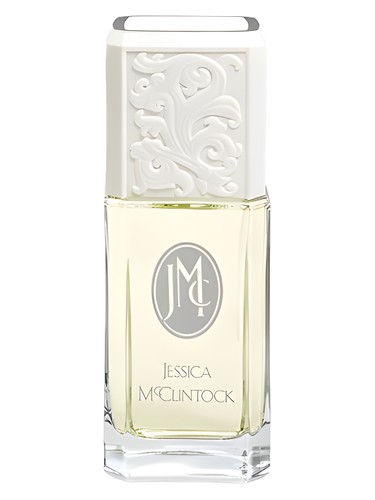
There''s something bittersweet about spraying Jessica McClintock today. The opening arrives with a burst of citrus brightness—lemon and bergamot dancing alongside the exotic sweetness of ylang-ylang. Basil adds an unexpected herbal edge, while cassia brings a whisper of spice and black currant contributes a jammy fruit note. It''s a fresh, optimistic opening that immediately telegraphs its late-eighties origins, when white florals ruled the fragrance counter and subtlety took a backseat to presence. But here''s the catch: if you wore this perfume in its heyday, what you''re experiencing now may bear little resemblance to what you remember.
The Scent Profile
The journey of Jessica McClintock unfolds as a classic white floral composition, dominated entirely by this accord at 100% intensity. After that vivacious opening—where citrus, green, and aromatic elements jostle for attention—the fragrance settles into its true heart: a trinity of white flowers that defined an era.
Lily-of-the-valley takes center stage, flanked by jasmine''s indolic richness and rose''s romantic softness. This combination creates that fresh, clean, almost soapy quality that made the original so memorable. The lily-of-the-valley note, in particular, was reportedly the star of the show, lending the fragrance its distinctive character—a delicate, green-tinged floral with an almost metallic brightness.
As the composition dries down, musk and woody notes provide a soft, skin-like foundation. These base notes don''t compete with the florals; instead, they act as a gentle cushion, extending the wear time without adding heaviness. The overall effect registers as 53% fresh, 45% green, with citrus and aromatic accords supporting the dominant white floral theme. It''s a composition built for approachability rather than complexity, designed to leave a pleasant, memorable trail without overwhelming.
Character & Occasion
The data tells a clear story: Jessica McClintock is a spring perfume through and through, scoring 100% for that season. It captures that feeling of renewal, of flowers blooming and sunshine returning. Summer follows closely at 61%, while fall and winter trail significantly behind at 21% and 17% respectively. This is emphatically not a cold-weather fragrance.
With a day-to-night ratio of 97% to 22%, Jessica McClintock is unambiguously a daytime scent. Picture it at brunch, in the office, running weekend errands, attending garden parties—anywhere that calls for approachable femininity rather than sultry evening drama. It''s the olfactory equivalent of a floral sundress, not a little black dress.
The fragrance speaks to a particular vision of femininity popular in its era: romantic, clean, unabashedly pretty. While it launched in 1988 alongside the designer''s signature wedding gowns and prom dresses, the scent carries that same aesthetic—aspirational yet accessible, special without being intimidating.
Community Verdict
Here''s where the story gets complicated. The Reddit fragrance community gives Jessica McClintock a mixed sentiment score of 5.5 out of 10, but that lukewarm rating masks a more nuanced reality. Those who remember the original speak of it with genuine nostalgia—it''s memorable, meaningful, and for many, tied to specific life moments. The fragrance remains affordable and accessible when you can find it, and its lily-of-the-valley composition was apparently unique.
But—and this is a significant "but"—IFRA restrictions on lily-of-the-valley materials have rendered the original formula impossible to reproduce. The current version sold today smells significantly different from what made Jessica McClintock famous. For those seeking to recapture a memory, this presents a heartbreaking obstacle. Finding exact dupes or alternatives has proven challenging for the community.
The practical recommendations reveal the dilemma: this fragrance is now best suited for nostalgia and personal memory, for vintage fragrance collectors willing to hunt down original formulations, or even as a room or linen spray alternative rather than a personal scent. Some community members suggest Jo Malone London Frangipani Flower as a potential alternative, though finding that perfect match remains elusive.
How It Compares
Jessica McClintock occupies interesting territory among its peers. It shares DNA with Estée Lauder''s Pleasures, another clean white floral from the nineties, and shows kinship with Givenchy''s Organza, Elizabeth Arden''s 5th Avenue, Dior''s J''adore, and Givenchy''s Amarige. These are the heavy hitters of accessible luxury white florals—fragrances that dominated department store counters and defined feminine fragrance for a generation.
Where Jessica McClintock distinguished itself was in that particular lily-of-the-valley focus and its positioning as both bridal and everyday. It was more affordable than J''adore, less aggressively floral than Amarige, and tied to an American rather than European fashion house. It occupied the sweet spot between aspirational and attainable.
The Bottom Line
With a rating of 3.94 out of 5 stars from 1,165 votes, Jessica McClintock sits comfortably in "liked but not loved" territory—and that rating likely reflects the reformulation disappointment as much as the fragrance itself. The original formula, by all accounts, deserved its place in late-eighties and nineties fragrance wardrobes. The current version? That''s harder to recommend with enthusiasm.
If you''re a vintage fragrance collector or someone who wore this in high school and wants to revisit that memory, hunting down an original bottle might be worth the effort. They''re still available at reasonable prices, offering a direct line to a specific moment in fragrance history. For those simply seeking a fresh white floral for daytime spring wear, the contemporary reformulation may disappoint—better to explore Pleasures or Jo Malone''s alternatives instead.
Jessica McClintock ultimately represents something larger than itself: the impermanence of fragrance, the way regulations and reformulations can transform beloved scents into strangers. It''s a reminder that sometimes, the best way to preserve a memory isn''t to recreate it, but to appreciate it for what it was—a perfect white floral of its moment, now preserved primarily in the minds of those who wore it when it mattered most.
AI-generated editorial review