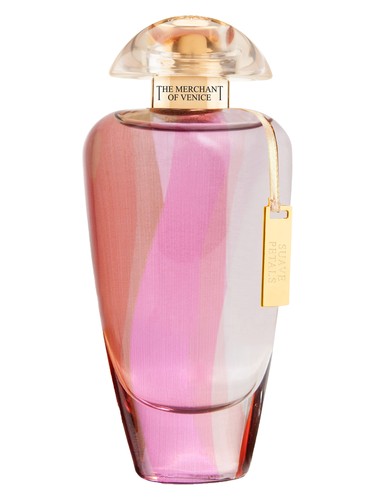
First Impressions
The first spray of Suave Petals reveals an immediate contradiction—and a delightful one at that. Despite its delicate name, this 2013 release from The Merchant of Venice announces itself with unexpected authority. A burst of nectarine blossom mingles with the fleshy sweetness of actual nectarine fruit, while pineapple and apple add a crisp, almost effervescent quality to the opening. There''s bergamot here too, lending a sophisticated citrus brightness that prevents the fruity accord from veering into candy territory. But here''s what catches you off guard: beneath this sun-drenched orchard opening, there''s already a whisper of something darker, woodier, more complex. This is no simple floral fruity fragrance pretending to be something it isn''t.
The Scent Profile
The evolution of Suave Petals is where its true character emerges, and it''s a journey that reveals careful construction. Those opening fruits—nectarine, pineapple, apple—create an impression of abundance without overwhelming. The nectarine blossom, in particular, walks a fine line between fruity and floral, serving as a bridge to what comes next.
As the fragrance settles into its heart, white florals take center stage in a quartet that could easily overwhelm in lesser hands. White rose provides the romantic anchor, while orris root introduces a distinctly powdery, almost makeup-like quality that the community data confirms as one of the dominant accords at 93%. Orange blossom brings its characteristic bitter-sweet facets, and tuberose—often the diva of white florals—adds its creamy, narcotic presence. Yet somehow, these florals don''t read as traditionally feminine or delicate. That woody accord (registering at 100% in the data) is already making itself known, grounding the flowers in something earthier.
The base is where Suave Petals makes its most decisive statement. Patchouli and sandalwood create a woody foundation that''s both substantial and smooth, while vanilla and amber add warmth and a subtle sweetness that reads as polished rather than cloying. This base explains why the fragrance scores so highly on woody accords while maintaining strong fruity (95%) and powdery (93%) characteristics. It''s an unusual balance—most fragrances lean decisively in one direction or another, but Suave Petals seems determined to occupy multiple territories at once.
Character & Occasion
Here''s where Suave Petals becomes particularly intriguing. The community data shows it as suitable for all seasons—a claim many fragrances make but few truly earn. In this case, the rating seems justified by the fragrance''s chameleon-like quality. The fruity-floral opening has enough brightness for spring and summer, while the woody, ambery base provides the warmth and depth that work in cooler months.
The day/night data is curiously absent (both at 0%), which initially seems like a limitation until you realize it might be more of a reflection of the fragrance''s versatility—or perhaps its identity crisis, depending on your perspective. This is a scent that doesn''t fit neatly into the traditional day-to-office or night-to-dinner categories. Instead, it occupies an interesting middle ground: polished enough for professional settings, interesting enough for social occasions, but perhaps not assertive enough to be a true evening statement scent.
The powdery accords and white florals suggest a refined, put-together aesthetic—someone who appreciates complexity but doesn''t need to announce it loudly. With its woody-fruity profile, Suave Petals suits those who find purely sweet fragrances too young and purely woody scents too austere.
Community Verdict
With a rating of 3.82 out of 5 based on 469 votes, Suave Petals sits firmly in "very good" territory without quite reaching "beloved" status. This is a respectable showing that suggests a fragrance that delivers quality and interest without necessarily inspiring devotion. The number of votes indicates a perfume that has found its audience but remains somewhat under the radar—not a blockbuster, but not obscure either.
That rating tells a story: this is a fragrance that satisfies without necessarily thrilling, that showcases skill without breaking new ground. It''s the kind of scent that earns appreciation rather than obsession, which isn''t a criticism so much as a characterization.
How It Compares
The list of similar fragrances reads like a who''s who of modern perfumery: Black Orchid, Dune, Coco Mademoiselle, Coco Noir, Angel. What''s fascinating is how disparate these references are—from the gothic opulence of Black Orchid to the minimalist elegance of Dune, from the fresh sophistication of Coco Mademoiselle to the gourmand drama of Angel.
This speaks to Suave Petals'' hybrid nature. It borrows the woody-ambery warmth of the Chanel fragrances, hints at the white floral richness of Black Orchid, and shares the fruity-sweet elements of Angel, yet doesn''t fully commit to any of these identities. In a lineup with these heavy-hitters, Suave Petals positions itself as the more restrained, versatile alternative—less daring, perhaps, but more wearable.
The Bottom Line
Suave Petals is a fragrance of contradictions that mostly work in its favor. It''s woody yet fruity, floral yet grounded, sweet yet sophisticated. The Merchant of Venice has created something that refuses easy categorization, and while that might prevent it from achieving cult status, it makes for an intriguing, versatile addition to a fragrance wardrobe.
At 3.82 out of 5, the community has spoken: this is a quality fragrance worth exploring, especially for those who appreciate complexity and versatility over singular, bold statements. It won''t be everyone''s signature scent, but it might be the perfect fragrance for those in-between moments when you want something more interesting than safe, but more wearable than daring. For the price point typical of niche Venetian perfumery, it offers solid craftsmanship and genuine versatility—a fragrance that earns its place through competence and charm rather than innovation.
AI-generated editorial review