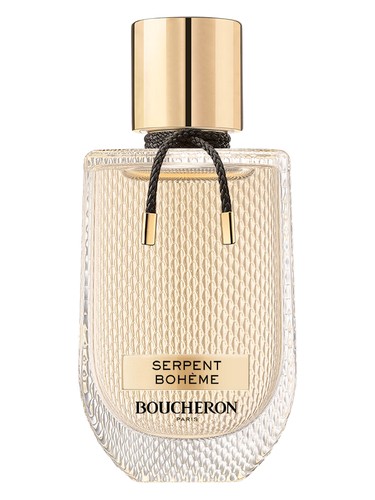
First Impressions
Serpent Bohème announces itself with a paradox—bright mandarin orange and tart black currant creating an almost cheerful greeting, yet there''s something knowing, something deeper lurking beneath. Within moments of meeting skin, this Boucheron creation reveals its true nature: not the fruity-floral confection that opening might suggest, but rather a sophisticated woody composition wearing flowers like elegant armor. The initial spray feels like stepping into a sun-drenched garden where citrus trees cast shadows over rose bushes, and the earth beneath tells half the story.
This is a fragrance that understands restraint. Released in 2020, Serpent Bohème takes the saturated floral market and whispers where others shout, building its presence through layers rather than volume. That serpent in its name? It''s there in the sinuous way the scent moves, shedding one skin to reveal another, never quite settling into the category you''d expect.
The Scent Profile
The mandarin and black currant opening is brief but essential—a flash of brightness that prepares you for the heart''s real statement. Within fifteen minutes, the fruity tang begins its retreat, making way for what Serpent Bohème truly wants to say: roses, plural, and not just any roses.
The heart reveals Turkish rose flanked by jasmine sambac and the more unusual desert rose, creating a triumvirate that avoids the powdery sweetness typical of rose-forward fragrances. The Turkish rose brings its classic, slightly spicy character, while the jasmine sambac adds an indolic richness that keeps things interesting. But it''s that desert rose—rare in mainstream perfumery—that provides the unexpected dimension, a leaner, more mineral quality that prevents the composition from veering into traditional territory.
This floral heart never stands alone. From the moment it blooms, you sense the base creeping upward: white musk and sandalwood providing a soft, almost cashmere-like texture. The interplay between florals and woods happens remarkably early, which explains why the woody accord registers at full intensity while florals hit 95%. They''re not sequential phases; they''re dance partners from nearly the first moment.
As hours pass, patchouli emerges with its earthy, slightly sweet character, while labdanum adds an ambery warmth that grounds everything. The sandalwood becomes more pronounced, creating that smooth, creamy foundation that the roses now rest upon rather than rise from. By the dry down—four to six hours in—you''re left with a musky-woody skin scent with just the ghost of roses, intimate and surprisingly tenacious.
Character & Occasion
Here''s where Serpent Bohème defies conventional wisdom. With such strong woody and musky accords, you''d expect a versatile day-to-night performer, perhaps leaning toward evening. Instead, the data tells a different story: this is overwhelmingly a daytime fragrance, perfect for spring (91%) and fall (86%), still workable in summer (66%), but decidedly less compelling in winter''s chill (37%).
Why? The composition, despite its woody dominance, maintains a freshness—that citrus opening, the airy quality of the white musk, the way the roses never become heavy or intoxicating. This is a fragrance for sunlight, for movement, for hours spent working, lunching, browsing. It''s sophisticated enough for professional settings yet relaxed enough for weekend errands. The 36% night rating isn''t a flaw; it''s simply honesty about what this fragrance does best.
The bohemian in its name proves apt. This suits the woman who pairs vintage blazers with worn denim, who brings fresh flowers to her desk, who values quality but scorns ostentation. It''s decidedly feminine without being delicate, grown-up without being severe.
Community Verdict
With 508 votes yielding a 3.84 out of 5 rating, Serpent Bohème occupies interesting territory. This isn''t a polarizing love-it-or-hate-it creation, nor is it a consensus masterpiece. Instead, it''s a well-executed fragrance that resonates solidly with those who discover it. That score suggests competence and charm rather than groundbreaking artistry—and sometimes that''s exactly what a collection needs.
The substantial vote count indicates genuine interest; this isn''t flying under the radar. People are finding it, testing it, forming opinions. That near-4 rating from over 500 reviewers signals a fragrance worth your attention, even if it may not become your signature.
How It Compares
The similar fragrances list reads like a who''s who of modern feminine woody-florals: both Narciso Rodriguez For Her and Narciso Poudree, Nomade by Chloé, and both Coco Mademoiselle and Coco Noir from Chanel. This places Serpent Bohème in seriously accomplished company.
Where Narciso Rodriguez''s musk-forward creations emphasize minimalism and Nomade goes nomadic with oakmoss and earthiness, Serpent Bohème stakes out middle ground—more floral than the Narcisos, less adventurous than Nomade, more approachable than Coco Noir''s gothic intensity. If Coco Mademoiselle represents polished Parisian chic, Serpent Bohème offers its bohemian sister—equally sophisticated, slightly less concerned with perfection.
The Bottom Line
Serpent Bohème won''t revolutionize your fragrance wardrobe, but it might become a reliable favorite. That 3.84 rating reflects genuine appreciation from a substantial community—this is a good fragrance doing exactly what it sets out to do. For a 2020 release from Boucheron, a house with serious high jewelry heritage, it translates that craftsmanship into olfactory form: well-constructed, balanced, wearable.
The value proposition depends on your collection''s gaps. If you''re drowning in fresh florals, this offers woody depth. If your shelf groans with heavy orientals, here''s approachable sophistication. Those seeking a spring-to-fall daytime signature with enough character to avoid boring but enough restraint to avoid overwhelming will find this particularly compelling.
Try Serpent Bohème if you''ve loved the Narciso Rodriguez aesthetic but want more florals, if Nomade intrigued you but felt too earthy, or if you simply need a grown-up rose that doesn''t announce itself three rooms away. Sometimes the serpent''s wisdom lies in knowing exactly when to strike—and when to simply bask in the sun.
AI-generated editorial review