First Impressions
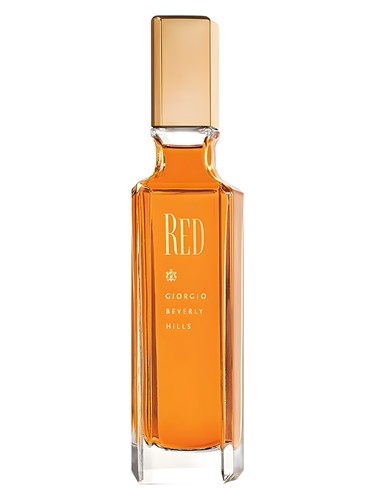
The first spray of Giorgio Beverly Hills Red announces itself like a limousine pulling up to a power lunch in 1989 Los Angeles. There''s an immediate burst of fruit and aldehydes—cherry and peach dancing with black currant—but this isn''t sweet in the modern gourmand sense. Instead, it''s a calculated opening salvo, the fruity notes acting as a glamorous veil over something far more substantial. Within seconds, the woody-amber foundation that defines this fragrance begins to emerge, creating a fascinating tension between the bright, almost playful top and the architectural density beneath. This is a perfume that arrived during the era of shoulder pads and statement jewelry, yet it possesses enough sophistication to transcend pure nostalgia.
The Scent Profile
Red''s evolution reveals a complexity that belies its bold reputation. The opening is a fruit basket tipped over at a flower market: cherry and peach mingle with the apricot-like sweetness of osmanthus, while ylang-ylang and orange blossom add an exotic richness. Aldehydes lift everything with that vintage sparkle—think champagne bubbles rather than soap—while hyacinth provides a green, slightly sharp edge that prevents the fruits from becoming cloying. Bergamot and black currant add brightness and depth simultaneously.
The heart is where Red transforms from power dressing accessory to serious perfumery. This is white floral territory with muscle: tuberose and gardenia create creamy opulence, while jasmine and lily-of-the-valley provide freshness. Rose and carnation—that spicy, peppery carnation that defined so many 80s fragrances—add structure. Most unexpectedly, rosemary appears alongside iris and litchi, creating an aromatic quality that keeps the florals from overwhelming. It''s a crowded stage, but everything plays its part.
The base is where Red earns its 100% woody accord rating. Oakmoss provides that classic chypre backbone (this is clearly from the era before IFRA restrictions), while sandalwood and cedar create a warm, substantial wood framework. Amber, myrrh, and olibanum add a resinous, almost incense-like quality—these aren''t decorative base notes but load-bearing pillars. Patchouli, vetiver, vanilla, and tonka bean round out the foundation with earthy sweetness. The drydown is remarkably long-lasting, settling into a skin-scent of ambered woods with lingering spice.
Character & Occasion
Red is unequivocally a cold-weather fragrance. With a 100% fall rating and 97% winter score, this perfume thrives when temperatures drop and layers come out. The woody-amber construction becomes suffocating in heat—that 14% summer rating isn''t an accident—but wrapped in cashmere when frost touches the windows, Red reveals its brilliance. Spring wearers (24%) are the brave souls who appreciate its weight even as the weather warms.
The day-to-night split is revealing: while 62% of wearers find it suitable for daytime, that 95% night rating tells the real story. This is a perfume that comes alive under artificial light, in restaurants with dress codes, at evening events where presence matters. It''s not a shrinking violet for the office—it projects—but it truly belongs to evening hours when its complexity and richness make sense.
Who is Red for? The wearer who appreciates vintage perfumery construction, who wants a scent with authority, who isn''t afraid of being noticed. This isn''t a safe choice or a crowd-pleaser in the modern sense. It''s for someone who finds contemporary fragrances too sheer, too sweet, or too timid.
Community Verdict
With a 3.87 out of 5 rating across 1,154 votes, Red occupies interesting territory. This isn''t universal adoration, but it''s solid appreciation from a substantial community. The rating suggests a fragrance that rewards those who seek it out—vintage lovers, woody-amber devotees, those nostalgic for big 80s perfumes—while acknowledging it won''t convert everyone. That''s honest, and in perfumery, polarization often signals a point of view. Red has a definite perspective, and nearly 1,200 people have engaged with it enough to vote, which speaks to lasting interest in a fragrance over three decades old.
How It Compares
Red sits comfortably alongside other sophisticated powerhouses from its era and slightly before. The comparison to Dior''s Poison makes sense—both are unapologetically bold—though Red skews more woody-amber where Poison emphasizes spice. Chanel''s Coco Eau de Parfum shares that amber-oriental richness with serious wood structure. Estée Lauder''s Knowing and Clinique''s Aromatics Elixir both occupy similar chypre-adjacent territory with that characteristic oakmoss backbone. Dune by Dior is perhaps the outlier here—more airy and ozonic—but shares Red''s woody foundation.
What distinguishes Red is its particular balance of fruit, white florals, and that commanding woody-amber base. It''s less overtly sexy than Poison, less severe than Aromatics Elixir, more directly glamorous than Dune.
The Bottom Line
Giorgio Beverly Hills Red is a time capsule with staying power. It captures a specific moment in perfumery—pre-reformulation oakmoss, generous white florals, unabashed projection—while maintaining enough quality in construction to remain relevant. That 3.87 rating reflects reality: this won''t be everyone''s signature scent, but for those who connect with it, it offers something increasingly rare in modern perfumery.
The value proposition is excellent if you can find it. Giorgio Beverly Hills fragrances often appear at accessible price points, making Red an affordable entry into serious vintage-style perfumery. It''s worth exploring if you love any of its siblings in the woody-amber-chypre family, if you mourn the loss of powerful fragrances, or if you''re simply curious about what power dressing smelled like in 1989. Just wait for cold weather, save it for evening, and prepare to make an impression.
AI-generated editorial review