First Impressions
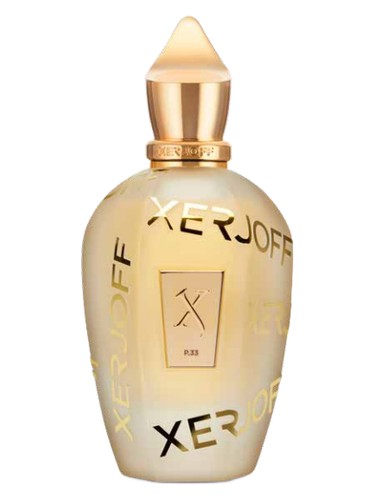
The first spray of P.33 announces itself with the kind of audacity that makes you immediately understand why Xerjoff left this one without a poetic name. Just a designation. A code. P.33 feels like an experiment that escaped the laboratory—beginning with a bright citrus cocktail of apple, bergamot, and grapefruit laced with pink pepper, but almost immediately revealing something stranger underneath. There''s a metallic edge here, something synthetic and smoky that hovers at the periphery of that opening brightness like an uninvited guest. This is not a fragrance that wants to be liked. It wants to be experienced, dissected, argued about.
The Scent Profile
The opening salvo features apple, bergamot, grapefruit, and pink pepper—a quartet that should theoretically deliver crisp, invigorating freshness. And it does, but with an asterisk. The apple reads less like fruit-basket sweetness and more like something observed through frosted glass, while the citrus elements carry an almost industrial brightness. The pink pepper adds a spicy metallic tingle rather than warmth, setting the stage for what''s to come.
As P.33 settles into its heart, the composition reveals its true character. Cypress brings a resinous, almost coniferous quality that anchors the woody accord dominating this fragrance at 100%. Iris appears not in its buttery, powdery form, but as something more austere and rooty—contributing to that 66% powdery accord while maintaining an unusual coolness. Cinnamon enters the scene but refuses to play the role of comforting spice; instead, it amplifies the aromatic qualities (58%) with a dusty, almost medicinal edge that some find fascinating and others find off-putting.
The base is surprisingly simple on paper—just musk—but this is where P.33 either wins you over or loses you entirely. The musk here doesn''t provide soft, skin-like intimacy. It''s synthetic, pronounced, and persistent, creating a woody-musky foundation that projects with remarkable tenacity. This streamlined base allows the unusual interplay of woody, citrus, and powdery accords to remain visible throughout the wear, never quite resolving into conventional beauty.
Character & Occasion
P.33 finds its sweet spot in the transitional seasons, scoring perfectly for spring (100%) and performing admirably through summer (91%) and fall (88%). Winter, at just 40%, proves less hospitable to its particular brand of cool, synthetic woods. This is decisively a daytime fragrance (95%), though its 68% night rating suggests it can transition into evening hours for those brave enough to carry its peculiarities into social settings.
But here''s where the data and reality diverge somewhat. While the seasonality suggests versatility, the community feedback tells a different story. This is primarily a personal fragrance—something to wear when you''re dressing for yourself rather than others. The extreme projection means even minimal application fills a room, making it potentially overwhelming in professional or intimate settings. Those experimental souls who appreciate unconventional compositions will find P.33 fascinating for private wear or situations where making a memorable (if polarizing) impression is the goal.
The feminine designation feels almost incidental; this fragrance operates in a space beyond traditional gender classifications, appealing more to collectors seeking unusual pieces than to those shopping by demographic categories.
Community Verdict
The Reddit fragrance community approaches P.33 with notable skepticism, awarding it a sentiment score of just 3.5 out of 10—a stark contrast to its more favorable 4.01/5 rating from the broader voting base. This disconnect reveals something crucial: P.33 attracts polarized responses.
The pros are admittedly compelling for a specific audience: its scent profile genuinely breaks conventions, Xerjoff''s pedigree ensures quality construction, and the ability to sample before committing to a full bottle prevents expensive mistakes.
The cons, however, are substantial and repeated across multiple opinions. The synthetic quality that some find intriguing strikes most as simply off-putting and weird. The extreme projection—mentioned consistently as requiring minimal application—transforms what might be an interesting olfactory curiosity into a potential public nuisance. Perhaps most damning, the community notes that P.33 either takes considerable time to appreciate or may simply never appeal, no matter how much you want to "get it."
The consensus positions P.33 firmly in experimental territory: a fragrance for collectors who value strangeness over wearability, and for those comfortable wearing scents that please only themselves.
How It Compares
The similar fragrances listed—Ani by Nishane, Reflection Man by Amouage, Layton by Parfums de Marly, Dior Homme Intense 2011, and Xerjoff''s own Alexandria II—share that woody-iris-powdery DNA, but most execute it with significantly more approachability. Dior Homme Intense, in particular, demonstrates how iris and woods can create sophisticated androgyny without alienating wearers. P.33 takes the road less traveled, sacrificing mass appeal for uncompromising individuality.
The Bottom Line
With 339 votes averaging 4.01 out of 5, P.33 clearly has its advocates—people who find its synthetic metallic woods and extreme presence exhilarating rather than exhausting. But the dramatically lower community sentiment (3.5/10) from those who''ve engaged with it more deeply suggests that initial intrigue often fails to mature into lasting appreciation.
This is a fragrance for the truly adventurous: collectors who want every unusual entry in the Xerjoff catalog, contrarians who enjoy wearing the unwearable, or those private moments when you want to smell interesting to yourself alone. For everyone else, P.33 represents a fascinating failure—proof that not every experiment should escape the laboratory, and that sometimes a code number is the only name a fragrance needs.
Sample first, apply sparingly, and don''t say you weren''t warned.
AI-generated editorial review