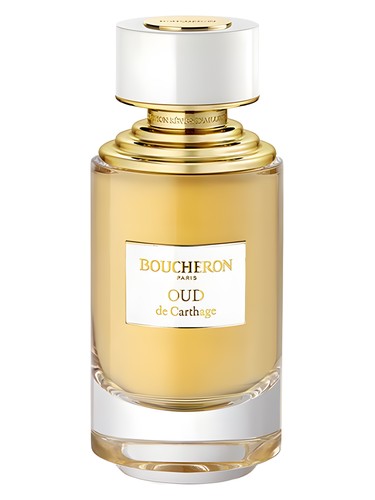
First Impressions
The first spray of Oud de Carthage is an arresting collision of the sacred and the sensual. Honey—not the delicate wildflower variety, but something darker, more resinous—meets billowing clouds of incense in an opening that feels both ancient and utterly contemporary. There''s an immediate warmth that radiates from the skin, a golden haze that announces your presence without shouting. This is Boucheron''s 2017 interpretation of oud through a distinctly feminine lens, though the composition challenges any rigid gender boundaries with its confident, amber-dominant backbone.
What strikes you within moments is the absence of the harsh medicinal edge that plagues many oud fragrances. Instead, this opening feels like stepping into a sun-warmed souk where honey sellers work beside frankincense vendors, their wares mingling in the air to create something entirely new.
The Scent Profile
The honeyed incense opening doesn''t fade so much as transform, deepening into a heart where tonka bean and labdanum weave a bridge between the initial sweetness and the leathery oud foundation to come. The tonka brings its characteristic almond-vanilla creaminess, but labdanum—that ambery, slightly animalic resin—provides the real structural magic here. It''s this middle phase where Oud de Carthage reveals its complexity, where the 66% honey accord begins to meld with the emerging leather notes, creating a texture that''s simultaneously plush and austere.
The progression feels inevitable rather than jarring, a slow unveiling rather than distinct phases. The incense from the opening persists as a smoky thread—that 55% smoky accord evident throughout—binding everything together with its sacred, ceremonial character.
As the fragrance settles into its base, the agarwood finally takes center stage alongside leather. But this is oud viewed through amber-tinted glasses—polished, refined, presented with that 100% amber accord acting as the dominant force. The leather isn''t sharp or aggressively modern; it carries the softness of well-worn gloves, perhaps a touch of suede. The oud itself, comprising 65% of the overall accord profile, remains rich and woody but never overwhelms. The balance speaks to careful composition: this is oud for those who appreciate its depth without wanting to be consumed by its sometimes polarizing intensity.
Character & Occasion
Oud de Carthage is unequivocally a cold-weather companion. The community data tells a clear story: fall wearability sits at 100%, with winter close behind at 93%. This makes perfect sense—the fragrance''s honey-amber-oud trinity demands cooler temperatures to truly shine. In spring (35%) it might work on particularly cool days, but summer (18%) seems almost laughable for a scent this enveloping.
The day versus night split reveals interesting versatility: 64% day wearability suggests it''s refined enough for professional settings, while the 87% night rating confirms where it truly excels. Imagine it in a dimly lit restaurant, across the table from someone leaning in to catch another trace of that honeyed smoke on your skin. Or in a gallery opening as autumn rain falls outside, the fragrance echoing the amber lighting on canvas.
This is marketed as a feminine fragrance, but those labels feel restrictive here. Anyone drawn to rich, ambery compositions with character will find something to love. It favors confidence over timidity—this isn''t a fragrance for those seeking to blend into the background.
Community Verdict
With a rating of 4.17 out of 5 across 504 votes, Oud de Carthage has earned genuine respect from those who''ve experienced it. This isn''t a niche obscurity with 20 devoted fans; over 500 people have weighed in, and the overwhelming majority approve. That rating places it firmly in "very good" territory—beloved without being universally worshipped, which often signals a fragrance with distinct character rather than crowd-pleasing blandness.
The relatively robust vote count suggests this has reached beyond just Boucheron devotees to find a broader audience, likely those exploring oud fragrances or seeking alternatives to more famous amber compositions.
How It Compares
The comparison list reads like a who''s who of prestigious amber and oud compositions. Being mentioned alongside Amouage''s Interlude Man and Nasomatto''s Black Afgano sets high expectations—these are cult favorites with fierce followings. The Serge Lutens connections (Chergui and Ambre Sultan) make particular sense given the honey-amber focus, while the nod to Boucheron''s own Ambre d''Alexandrie suggests a house signature style.
What distinguishes Oud de Carthage is its particular balance: less opulent and spice-forward than Interlude Man, more approachable than the dark intensity of Black Afgano, but more explicitly oud-focused than the hay-honey warmth of Chergui. It occupies a sweet spot between accessibility and exoticism.
The Bottom Line
Oud de Carthage deserves its 4.17 rating. It''s a fragrance that accomplishes something genuinely difficult: making oud wearable and even elegant while maintaining enough character to avoid becoming just another safe amber. The honey-incense opening is memorable, the dry down is sophisticated, and the overall experience feels cohesive rather than disjointed.
Is it groundbreaking? Perhaps not. But it''s exceptionally well-executed, and sometimes that matters more than innovation. For someone looking to explore oud without diving into the deep end of medicinal intensity, this provides an elegant entry point. For those already versed in oud compositions, it offers a feminine perspective that feels fresh without pandering.
The value proposition depends on your access—Boucheron''s prestige line occasionally appears at compelling prices, making it worth hunting for deals. At full retail, you''re paying for quality materials and a well-regarded house name.
Try this if you love amber fragrances and wonder what they''d be like with more depth. Try it if oud intrigues but intimidates you. Try it if you want something that makes cold evenings feel just a bit more luxurious. Just don''t try it in July—both you and the fragrance deserve better.
AI-generated editorial review