First Impressions
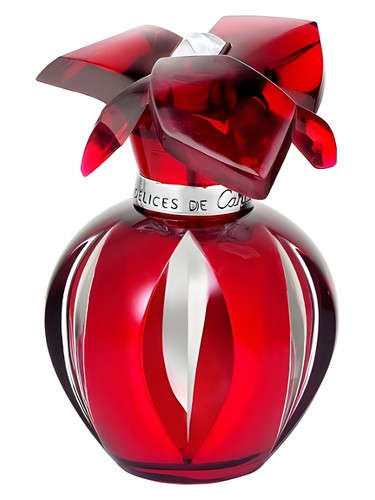
The first spray of Délices de Cartier delivers exactly what its name promises: delights, plural and unabashed. A burst of cherry—ripe, almost candied, but refined—announces itself with the confidence of a luxury house that knows its heritage. This isn''t the maraschino cherry of drugstore lip gloss; it''s cherry filtered through Cartier''s jewel-box aesthetic, dusted with pink pepper that adds a subtle fizz to the fruit. Bergamot weaves through like a citrus ribbon, tempering the sweetness just enough to remind you this is an eau de parfum, not a dessert menu.
Within moments, you understand the duality at play here: Cartier has created something genuinely sweet—the cherry accord registers at full intensity—while maintaining the architectural sophistication expected from a house better known for panthers and red boxes than confections.
The Scent Profile
The opening act belongs entirely to that cherry note, which dominates with a 100% accord presence. It''s accompanied by pink pepper''s gentle heat and bergamot''s bright citrus edge, creating a trinity that feels simultaneously playful and polished. The pink pepper deserves special mention; rather than overwhelming the composition with spice, it acts as a bridge between the fruit and what''s coming next, adding dimension without aggression.
As the fragrance settles into its heart, a classic floral trio emerges: violet, jasmine, and freesia. The violet is particularly notable, contributing to the powdery character (60% accord) that softens the cherry''s initial boldness. This isn''t a showy floral phase—the blossoms blend rather than compete, creating a hazy, romantic middle ground where sweetness meets something more contemplative. The jasmine adds just enough white-floral richness to anchor the composition, while freesia keeps things airy and modern.
The base is where Délices reveals its true ambitions as a winter-worthy fragrance. Tonka bean brings its characteristic vanilla-almond warmth (reflected in the 42% vanilla accord), while amber adds resinous depth (70% accord presence). Sandalwood and musk create a soft, skin-like foundation that allows the sweeter elements to glow rather than shout. This base is what transforms a cherry-forward fragrance into something you can wear into evening without feeling frivolous—the 93% night-wear rating isn''t accidental.
The overall composition leans decidedly sweet (91% accord), but it''s a sophisticated sweetness, the kind that knows when to whisper rather than sing.
Character & Occasion
Délices de Cartier is emphatically a cold-weather companion. The data tells a clear story: 100% winter suitability, 81% for fall, dropping to just 33% for summer. This makes perfect sense when you consider the amber-tonka-cherry combination, which would feel cloying in August humidity but wraps you like cashmere when temperatures drop.
Interestingly, while the fragrance performs well during daytime (77%), it truly comes alive at night (93%). This suggests a perfume that adapts to context—appropriate for the office or weekend errands, but gaining confidence and projection as evening approaches. The cherry sweetness that might feel almost innocent at noon takes on a more sensual, enveloping quality against cold night air.
This is a fragrance for someone who appreciates gourmand elements but doesn''t want to smell like a cupcake. It''s for the woman who owns statement coats, drinks wine instead of cocktails, and understands that sweetness doesn''t preclude sophistication. Age-wise, it skews more mature than teen-targeted cherry bombs, though it''s playful enough for someone who refuses to take herself too seriously.
Community Verdict
With a rating of 3.79 out of 5 across 990 votes, Délices de Cartier sits comfortably in "very good" territory without quite reaching "masterpiece" status. This is a respectable showing that suggests broad appeal with some reservations. The rating implies a well-executed fragrance that delivers on its promises, though perhaps without the uniqueness or complexity that would push it above 4.0.
The substantial vote count—nearly a thousand reviews—indicates this isn''t an obscure flanker but a fragrance that''s gained legitimate attention and testing over its fifteen-year life. That solid mid-to-high rating across so many wearers suggests consistency and quality, even if it doesn''t inspire universal obsession.
How It Compares
Cartier positions Délices among formidable company. The similarities to Chanel''s Coco Eau de Parfum and Dior''s Poison suggest shared DNA in the amber-oriental territory, while connections to Lolita Lempicka and La Vie Est Belle point to the gourmand-sweet aspect. The Yves Saint Laurent Cinéma comparison hints at the vintage-inspired, powdery sophistication underneath the fruit.
Where Délices distinguishes itself is in its cherry-forward approach—neither Coco nor Poison lead with fruit quite so boldly. It''s sweeter than Poison, less overtly sensual than Coco, and more refined than Lolita Lempicka''s licorice-violet sweetness. Think of it as Cartier''s answer to the gourmand trend: acknowledging contemporary tastes while maintaining classical structure.
The Bottom Line
Délices de Cartier proves that a heritage jewelry house can craft a legitimately appealing gourmand fragrance without compromising its identity. The 3.79 rating reflects a perfume that''s technically accomplished and broadly wearable, even if it doesn''t break new ground. For those seeking a cherry-centered fragrance with genuine elegance, this delivers beyond the typical fruit-bomb offerings.
The sweet-but-sophisticated balance makes it particularly valuable for someone building a cold-weather rotation who wants something more approachable than Poison but more substantial than La Vie Est Belle. Given Cartier''s positioning, it offers solid value—luxury house prestige without niche pricing.
Should you try it? Yes, particularly if you''ve aged out of overtly young fruity fragrances but still want that cherry-vanilla comfort. Just remember: this is a winter romance, not a summer fling. Save it for cool evenings, and let that amber-cherry embrace remind you why sometimes, the classics—with a playful twist—endure.
AI-generated editorial review