First Impressions
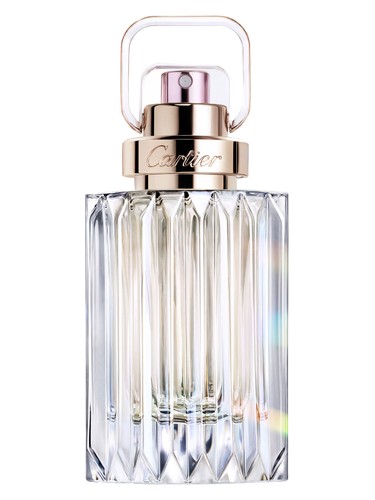
Spritz Cartier Carat onto your wrist and you''re immediately transported to a garden cocktail party where nature meets sophistication. The opening is decidedly green—a verdant, almost photorealistic burst that reads like crushed stems and dew-laden leaves. But this isn''t a soft, romantic green. It''s the crisp snap of a pear being sliced on marble, accompanied by bergamot''s bright citrus sparkle. There''s something immediately cocktail-like about this introduction, a martini-glass elegance that feels both refreshing and slightly sharp. It''s as if Cartier took the idea of their famous jewelry—faceted, brilliant, multidimensional—and translated it into liquid form. The result is undeniably striking, though whether it dazzles or cuts depends entirely on who''s wearing it.
The Scent Profile
Carat''s evolution is a study in floral abundance, for better or worse. After that green-fruity opening—where pear takes center stage alongside bergamot''s citrus lift and those aggressively fresh green notes—the fragrance transitions into a veritable bouquet. And we''re not talking a small arrangement here. Hyacinth, tulip, narcissus, lily, honeysuckle, violet, and ylang-ylang all compete for attention in the heart, creating what the data confirms as an 82% floral accord with significant yellow floral (71%) and white floral (53%) presences.
The hyacinth and tulip lead this floral brigade, bringing that characteristic spring garden quality—slightly watery, slightly green, but with a soapy cleanness that can read as either refreshing or sterile depending on your perspective. The narcissus adds a creamy sweetness, while the ylang-ylang contributes tropical richness. Yet somehow, despite this roster of soft, traditionally romantic flowers, many wearers find the effect surprisingly cold and sharp rather than warm and embracing.
The base attempts to soften this botanical assault with mimosa and white musk. Mimosa brings its characteristic powdery, slightly honeyed quality (reflected in that 39% powdery accord), while white musk provides the clean, skin-like foundation that so many modern fragrances rely upon. It''s here that Carat finally settles, though whether it settles comfortably is another question entirely.
Character & Occasion
The data speaks clearly: Carat is a spring fragrance first and foremost (100%), with significant summer viability (61%). This makes perfect sense given its green-floral DNA and crisp character. It''s the olfactory equivalent of those first warm days when tulips push through the soil and garden parties migrate outdoors. Fall sees a considerable drop (31%), and winter barely registers (18%)—this is not a fragrance that will comfort you through cold weather.
The day/night breakdown is even more decisive: 92% day versus a mere 14% night. Carat is clearly designed for daylight hours, whether that''s a business lunch, afternoon shopping, or a spring brunch. There''s something about its brightness and that cocktail-inspired opening that makes it feel appropriate for waking hours rather than evening romance.
This is a fragrance for those who appreciate the marriage of fruit and florals, who don''t mind their perfumes projecting with confidence, and who perhaps already love Cartier''s approach to scent. It''s decidedly feminine in presentation and best suited to special daytime occasions rather than daily wear—there''s an event-ready quality to its composition that might feel like too much for casual moments.
Community Verdict
With a rating of 3.84 out of 5 across 2,114 votes and a community sentiment score of 6.2 out of 10, Carat sits firmly in "mixed" territory. The Reddit fragrance community''s 54 collected opinions reveal a polarizing scent that delivers very different experiences depending on the wearer.
On the positive side, enthusiasts praise that cocktail-inspired quality, specifically calling out the pear and lychee martini vibe (though lychee isn''t listed in the notes, the combination clearly evokes it). Existing Cartier fragrance fans tend to appreciate it, and the fruity opening notes garner specific praise for their interest and vibrancy.
The criticisms, however, are pointed. Multiple reviewers describe the florals as "sharp and cold," with a muddled quality that becomes overpowering rather than harmonious. Perhaps most tellingly, many note that despite marketing suggesting softness and dewiness, Carat lacks these qualities entirely. Comparisons to La Tulipe by Byredo fall flat, with wearers finding Carat significantly less soft than advertised. This disconnect between expectation and reality seems to drive much of the disappointment.
How It Compares
Cartier positions Carat alongside some serious heavy-hitters: Poème by Lancôme, Chance Eau Tendre by Chanel, J''adore by Dior, Baiser Volé by Cartier, and Un Jardin Sur Le Nil by Hermès. These are all respected green-floral or floral-fresh fragrances with strong market presence.
The comparison is both flattering and revealing. Like J''adore, Carat aims for floral radiance, but where Dior''s masterpiece achieves creamy sophistication, Carat reads sharper and greener. Chance Eau Tendre''s gentle fruitiness seems more approachable than Carat''s more assertive opening. Un Jardin Sur Le Nil shares that green, garden-like quality but maintains better balance. Even within Cartier''s own line, Baiser Volé''s focused lily composition feels more refined than Carat''s everything-and-the-kitchen-sink approach.
The Bottom Line
Carat is a fragrance that lives up to its name in unexpected ways—it''s brilliant, multifaceted, and undeniably attention-grabbing, but like a diamond, it can also feel cold and unyielding. The 3.84 rating reflects a competent but not exceptional fragrance, one that finds its devotees but leaves many others underwhelmed.
If you''re someone who loves that intersection of fresh fruit and bright florals, who appreciates a confident spring scent, and who isn''t bothered by projection and sharpness, Carat deserves a test. Existing fans of Cartier''s fragrance aesthetic will likely find something to appreciate here. However, if you''re seeking softness, romance, or that dewy garden quality the marketing might suggest, you''ll likely join the disappointed camp.
Sample before you commit to a full bottle—this is emphatically a try-before-you-buy fragrance given its polarizing nature.
AI-generated editorial review