First Impressions
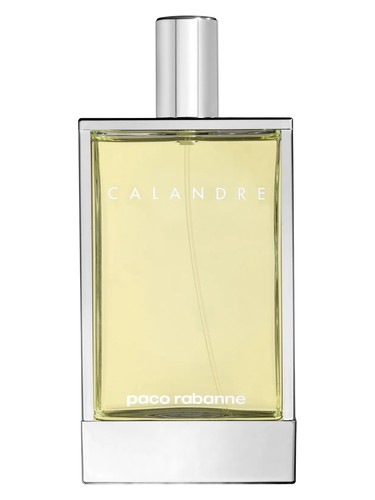
The first spray of Calandre is a clarion call from 1969—sharp, unapologetic, and startlingly modern even today. This is not a fragrance that whispers; it announces. A blast of metallic aldehydes collides with razor-sharp green notes and bergamot, creating an opening that feels more architectural than botanical. There''s an almost industrial quality to its initial moments, like sunlight glinting off polished chrome or the austere beauty of a Le Corbusier building. This was Paco Rabanne''s olfactory manifesto, as radical in its way as his chainmail dresses—a scent designed to challenge expectations of what a feminine fragrance could be.
The Scent Profile
Calandre''s structure reveals itself in precisely engineered layers, each phase distinct yet seamlessly connected. Those opening aldehydes dominate with a full 87% presence in the accord profile, creating a soapy, almost ozonic quality that defined an era. The green notes—registering at a perfect 100%—provide the fragrance''s backbone, an uncompromising verdancy that never softens into prettiness.
As the initial sharpness settles, the heart reveals unexpected complexity. Rose, lily-of-the-valley, and jasmine form a floral triumvirate, but these aren''t your grandmother''s garden flowers. The rose accord (73% of the profile) reads cool and dewy rather than romantic, its petals seemingly dusted with frost. Orris root lends a powdery, almost metallic quality, while hyacinth and geranium add green-tinged facets that reinforce rather than contradict the opening. This is a floral arrangement viewed through a modernist lens—geometry over abundance, structure over sentimentality.
The base anchors everything in earth and wood. Oakmoss provides that classic chypre foundation (contributing to the 71% earthy accord), while vetiver adds its characteristic grassiness and slight smokiness. Sandalwood and amber offer warmth without sweetness, and musk rounds out the composition with a skin-like quality that finally brings some softness to Calandre''s angular edges. The woody notes (65% of the profile) ensure the fragrance maintains its architectural quality right through the drydown, never collapsing into conventional femininity.
Character & Occasion
Calandre shows a decisive preference for daylight, rating 100% as a daytime fragrance compared to just 53% for evening wear. This makes perfect sense—its crisp, office-appropriate character feels most at home in professional settings or daytime activities where its freshness (80% in the accord profile) can truly shine.
Seasonally, spring claims Calandre as its own with a 90% rating, followed by fall at 72%. The fragrance''s green intensity feels perfectly aligned with spring''s new growth and crisp air, while its earthy base notes and substantial structure carry it confidently into autumn. Summer (59%) and winter (52%) are less ideal but not impossible—just be prepared for a more assertive presence in heat and potentially muted performance in cold.
This is emphatically not a fragrance for everyone. Its vintage DNA and uncompromising character demand a wearer with confidence and an appreciation for perfumery history. Those who gravitate toward safe, crowd-pleasing scents should look elsewhere. But for someone seeking to project intelligence, independence, and a certain cool remove, Calandre offers a signature like no other.
Community Verdict
The fragrance community''s relationship with Calandre is, in a word, complicated. With a sentiment score of 6.5 out of 10 based on 13 opinions, it sits firmly in "mixed" territory—respected but not universally loved.
The pros are significant: experts consistently cite its historical importance and critical acclaim among perfumers. The composition quality receives high marks for complexity and craftsmanship, particularly in extrait concentration where longevity and projection reach their full potential. This is undeniably a benchmark fragrance that changed the conversation about what women''s perfumes could be.
But the cons are equally substantial. The scent profile proves deeply polarizing—what some find sophisticated, others dismiss as harsh or dated. Multiple community members describe it as "too old-fashioned" or even "too masculine" by contemporary standards. Perhaps most concerning for potential buyers, longevity reports vary wildly, with some wearers experiencing moderate to poor performance despite the fragrance''s reputation.
The community consensus? Calandre works best for perfume collectors and those who genuinely appreciate vintage compositions. It''s emphatically not a blind-buy candidate—sampling is essential. Many prefer modern green fragrances over this pioneering original, finding its sharp edges difficult to wear in 2024.
How It Compares
Calandre sits among legendary company in the green aldehydic category. Its closest relatives include Yves Saint Laurent''s Rive Gauche, Chanel N°19, Van Cleef & Arpels'' First, Estée Lauder''s Knowing, and Lanvin''s Arpège. What distinguishes Calandre is its particularly metallic, almost industrial quality—where N°19 feels aristocratic and Rive Gauche artistic, Calandre channels modernist architecture and space-age aesthetics. It''s the most uncompromising of the group, the least interested in conventional beauty.
The Bottom Line
Calandre''s 4.2 out of 5 rating from 1,308 voters tells an interesting story. That''s solid approval, but not the universal acclaim of true crowd-pleasers. This is a fragrance that inspires devotion in its admirers and bewilderment in its detractors—exactly as Paco Rabanne likely intended.
Should you try it? If you collect vintage fragrances or study perfume history, absolutely. If you''re drawn to green scents but find most too soft or conventional, Calandre might be your revelation. If you want to smell unlike anyone else in 2024, here''s your weapon.
But approach with realistic expectations. This isn''t an easy wear, performance may disappoint, and you might simply find it too austere for your taste. Sample first, ideally in multiple concentrations. And if it doesn''t work for you, that''s fine—Calandre has never needed universal approval. It remains what it was in 1969: a brilliant, uncompromising vision of modernist perfumery, as challenging and rewarding today as it was revolutionary then.
AI-generated editorial review