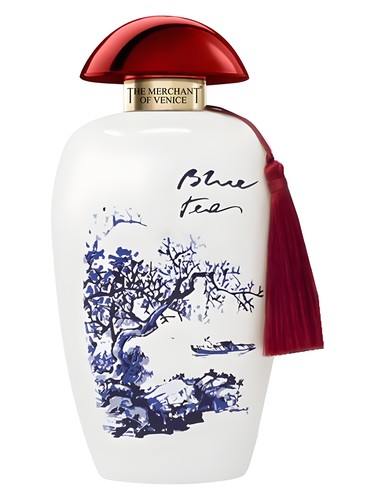
First Impressions
The first spray of Blue Tea transports you to a sunlit terrace where steam rises from a porcelain cup, carrying whispers of something both familiar and exotic. This isn''t the predictable green tea opening you might expect—instead, The Merchant of Venice has orchestrated an unexpected dance between delicate tea leaves and warm nutmeg spice. It''s a paradox that works beautifully: the coolness of tea meets the gentle heat of nutmeg, creating an opening that feels simultaneously refreshing and comforting. There''s an immediate brightness here, a green-citrus glow that suggests mornings rather than evenings, awakening rather than winding down.
The Scent Profile
Blue Tea''s journey begins with its namesake ingredient, but the tea note here isn''t a simple recreation. It''s nuanced—slightly vegetal, crisp, with that characteristic astringency that makes your senses snap to attention. The nutmeg addition is cleverly restrained, providing just enough spicy warmth to prevent the tea from feeling too linear or aqueous. Together, they create an opening that reads as both green and fresh-spicy, a combination that the community has clearly recognized in their accord assessments.
As the fragrance settles into its heart, a lush floral trio emerges: magnolia, neroli, and rose. This is where Blue Tea reveals its predominantly floral soul—that 100% floral accord rating isn''t an exaggeration. The magnolia brings a creamy, slightly lemonic quality that bridges the gap between the citrus-tinged opening and the more classical floral heart. Neroli adds its characteristic bitter-orange brightness, maintaining the composition''s essential freshness while introducing a sophisticated aromatic dimension. The rose, rather than dominating, weaves through these lighter florals like a thread of pink silk, adding depth without overwhelming the composition''s airy character.
What''s particularly interesting about Blue Tea is what it doesn''t have: traditional base notes. This absence is actually its strength. Without heavy musks, woods, or resins anchoring the composition, the fragrance maintains its ethereal, garden-fresh quality from beginning to end. It doesn''t so much evolve downward into a base as it does expand outward, the florals gradually softening and becoming more diffuse, like petals scattered on water.
Character & Occasion
Blue Tea is unequivocally a daytime fragrance, and the community data confirms this emphatically—95% day versus just 20% night wear. This is the scent of productive mornings, leisurely brunches, and afternoon garden parties. It thrives in spring, where it perfectly captures that season''s promise of renewal, and it transitions seamlessly into summer with a freshness that never feels heavy or cloying.
The seasonal breakdown tells a clear story: this is fundamentally a warm-weather fragrance, with spring at 100% and summer close behind at 94%. It can work in early fall (37%), particularly those bright September days that still hold summer''s memory, but winter at 19% suggests you''ll want to reach for something warmer during colder months.
Who is Blue Tea for? The feminine classification feels accurate, though not in a traditionally "girly" sense. This is refined femininity with a green, slightly intellectual edge—perfect for someone who appreciates understated elegance over loud declarations. It''s professional enough for the office yet personal enough for weekends. It whispers rather than shouts.
Community Verdict
With a solid 3.95 out of 5 rating based on 521 votes, Blue Tea has found its admirers without becoming a universal crowd-pleaser—and that''s perfectly fine. This rating suggests a well-executed fragrance that delivers on its promise, though perhaps without the groundbreaking innovation or mass appeal that would push it above 4.0. The substantial vote count indicates genuine interest and sustained attention, not just a flash-in-the-pan release. This is a fragrance people are actually wearing and forming opinions about.
How It Compares
Blue Tea finds itself in distinguished company among its similar fragrances. The comparison to Hermès'' Un Jardin Sur Le Nil makes perfect sense—both capture that green, watery freshness with floral accents. Etat Libre d''Orange''s You Or Someone Like You shares that tea-forward character, while Memo Paris''s Winter Palace offers another take on floral tea compositions. Interestingly, it''s also compared to its own sibling, Gyokuro, suggesting The Merchant of Venice has carved out a particular expertise in tea-based fragrances. The inclusion of Byredo''s Bal d''Afrique in the comparison set speaks to Blue Tea''s aromatic freshness and sophisticated floral work.
Within this category of fresh, tea-inflected florals, Blue Tea distinguishes itself through its particular spice accent and its commitment to remaining light and airy throughout its wear.
The Bottom Line
Blue Tea isn''t trying to be revolutionary, and that''s precisely its charm. This is a beautifully crafted spring and summer fragrance that knows exactly what it wants to be: a fresh, floral, daytime companion with enough complexity to remain interesting but enough restraint to never become overwhelming. The 3.95 rating reflects a fragrance that''s very good at what it does, even if what it does won''t appeal to everyone.
For lovers of green florals, tea fragrances, or anyone seeking an elegant warm-weather scent, Blue Tea deserves a try. It''s particularly worth exploring if you''ve enjoyed the Hermès garden series or if you''re curious about The Merchant of Venice''s approach to modern Italian perfumery. Just remember: this is daylight in a bottle, meant for when the sun is high and possibilities feel endless.
AI-generated editorial review