First Impressions
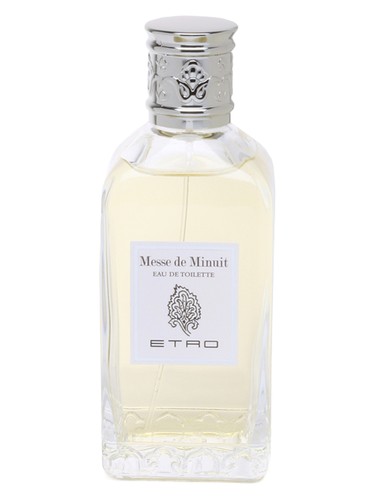
The first spray of Messe de Minuit—"Midnight Mass" in French—presents an intriguing paradox. This is church incense refracted through Mediterranean sunshine, a composition that manages to feel both reverential and surprisingly bright. The opening bursts with a trinity of citrus: orange, lemon, and bergamot, each cutting through the air with crystalline clarity. Yet even in these first moments, something deeper whispers beneath—a hint of resinous warmth that suggests the sacred spaces promised by its name. This isn''t the heavy, somber incense you might expect from a fragrance invoking midnight liturgy. Instead, Etro created something more nuanced in 1994: a feminine composition that treats church ritual as inspiration rather than imitation, resulting in a scent that feels both ancient and strangely contemporary.
The Scent Profile
The citrus opening—dominant at 96% according to its accord profile—maintains remarkable presence throughout Messe de Minuit''s evolution. That initial burst of orange, lemon, and bergamot doesn''t simply vanish as many top notes do; rather, it weaves throughout the composition, continually refreshing what could otherwise become oppressively resinous.
As the fragrance settles into its heart, the true complexity emerges. Myrrh appears twice in Etro''s formula—both in the heart and base—anchoring the composition with its distinctive bitter-sweet, slightly medicinal character. Cinnamon adds warmth without veering into holiday candle territory, while patchouli contributes an earthy depth. The inclusion of both citron and petitgrain in the heart is clever; they extend that citrus brightness while adding green, slightly woody facets that bridge the gap between the sparkling opening and the profound base.
The base notes reveal where Messe de Minuit earns its 100% amber accord rating. Here, myrrh and incense create the liturgical backbone, evoking thuribles swinging in darkened naves. Labdanum brings its characteristic amber warmth—leathery, slightly animalic, profoundly comforting. Honey softens the composition''s ecclesiastical severity with golden sweetness, while musk provides a subtle skin-like quality that keeps everything tethered to the wearer rather than floating off into pure abstraction. The result reads as 48% balsamic and 39% sweet, with a notable 69% warm spicy presence that prevents the amber from becoming too soft or powdery.
Character & Occasion
The community data tells a clear story: Messe de Minuit is a cold-weather companion, scoring 100% for fall and 95% for winter. This makes perfect sense given its resinous, amber-forward construction. The fragrance has weight and presence, wrapping the wearer in layers of warmth that feel almost protective when temperatures drop. Spring receives a modest 38% approval, while summer trails at just 25%—the honey and labdanum would likely feel suffocating in heat.
Interestingly, while marketed as feminine, Messe de Minuit reads more as quietly unisex to modern sensibilities. The incense and myrrh give it a gravitas that transcends traditional gender categories, though the honey and the particular treatment of the amber lean slightly feminine. This is a scent for someone who appreciates complexity over immediate prettiness, depth over sparkle.
The day versus night split is revealing: 73% day approval versus 82% night. Messe de Minuit works beautifully in daylight, particularly on gray autumn afternoons or crisp winter mornings, where its citrus elements keep it appropriate for professional settings. Yet it truly comes alive at night, when its amber and incense can fully bloom without competing with sunshine. This is a fragrance for art gallery openings, winter dinners, evening services, contemplative walks through old cities.
Community Verdict
With a rating of 4.11 out of 5 from 1,230 votes, Messe de Minuit has earned genuine admiration from those who''ve discovered it. That vote count—substantial but not massive—suggests this remains somewhat under the radar, a treasure for those willing to explore beyond mainstream releases. The rating itself indicates consistent quality; this isn''t a polarizing composition that some adore and others despise, but rather a well-crafted fragrance that delivers on its promise.
How It Compares
The similar fragrances list reads like a who''s who of sophisticated amber and incense compositions. Guerlain''s Shalimar Eau de Parfum shares the amber warmth but leans more overtly sensual. Comme des Garcons'' Avignon is purer, more austere in its incense focus—less Mediterranean sunshine, more stone cathedral. Chanel''s Coco offers comparable spiced amber but with more pronounced oriental florals. Serge Lutens'' Ambre Sultan brings similar honey-amber richness but with a denser, more North African character. L''Artisan Parfumeur''s Timbuktu shares the incense and vetiver earthiness but reads more masculine.
Where Messe de Minuit distinguishes itself is in that persistent citrus element—the way it keeps the composition from becoming too heavy or impenetrable. It''s the most "lifted" of these comparisons, the most likely to feel comfortable rather than challenging.
The Bottom Line
Messe de Minuit deserves more attention than it receives. In an era when many brands are reformulating or discontinuing their more challenging compositions, this 1994 creation represents thoughtful perfumery that trusts the wearer''s intelligence. The 4.11 rating feels accurate—this is very good work, if not quite transcendent.
For those who love amber fragrances but find many too sweet or too heavy, Messe de Minuit offers a more dynamic alternative. The citrus backbone keeps it wearable even as the incense and resins satisfy cravings for depth. It''s particularly recommended for anyone who appreciates the fragrances on that comparison list but wants something slightly brighter, more versatile, or more affordable.
This is a fragrance for cool weather contemplation, for those who find beauty in restraint, and for anyone who believes that sacred spaces—whether architectural or olfactory—need not be solemn to be profound.
AI-generated editorial review