First Impressions
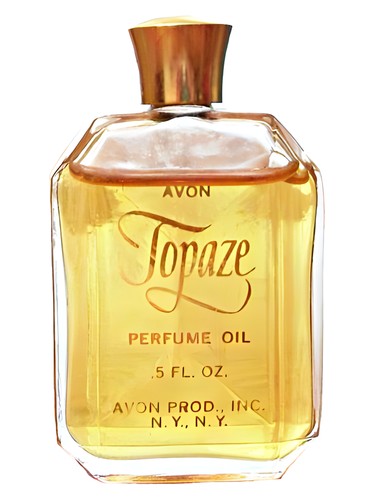
The first spray of Topaze is a time machine, transporting you instantly to an era when femininity wore gloves and lipstick was never optional. A brilliant burst of aldehydes lifts off the skin—that unmistakable champagne sparkle that defined elegance in the late 1950s. But this isn''t a museum piece gathering dust; the aldehydes are tempered by ripe peach and bright citrus, creating an opening that feels simultaneously vintage and wearable. There''s a crispness here, enhanced by an unexpected whisper of coriander, that keeps the composition from tipping into soapy nostalgia. Within moments, you understand why Avon chose to name this fragrance after a golden-hued gemstone: it radiates warmth and precious refinement from the very first encounter.
The Scent Profile
Topaze reveals itself in the classical manner of mid-century perfumery—patient, deliberate, and layered with intention. Those opening aldehydes, paired with bergamot and lemon, create an effervescent introduction that feels clean without being austere. The peach adds a velvet softness, while coriander provides an aromatic edge that distinguishes this from more straightforward aldehydic florals of its era.
As the fragrance settles into its heart, a lavish bouquet emerges. Carnation takes center stage with its spicy, clove-like warmth—a hallmark of vintage feminines that''s become increasingly rare in modern compositions. It''s joined by ylang-ylang''s creamy exoticism and the powdery sophistication of iris. Rose and jasmine weave through the arrangement, never dominating but adding depth and richness, while lily-of-the-valley contributes a green, innocent sweetness that prevents the heart from becoming too heavy or overtly seductive.
The base is where Topaze truly establishes its amber-dominant character. Sandalwood provides a creamy, woody foundation, while amber and benzoin create a resinous warmth that envelops the skin like cashmere. Civet—likely synthetic even in 1959, but effective nonetheless—adds a subtle animalic pulse that gives the fragrance its vintage soul. Vetiver brings an earthy, slightly smoky quality, and tonka bean rounds everything out with its sweet, hay-like smoothness. The result is a base that feels substantial and enduring, the kind that leaves a gentle trail hours after application.
Character & Occasion
Topaze is overwhelmingly an autumn fragrance, and the data confirms what your nose already knows: this is a scent that comes alive when the air turns crisp and wardrobes shift to wool. With 99% of wearers favoring it for fall, it''s a fragrance that seems designed for crunching leaves and early sunsets. Winter follows closely at 88%, where its amber warmth provides genuine comfort against the cold. Spring wearability drops to 69%—still respectable, particularly for cooler spring days—while summer, at 39%, is where Topaze shows its limitations. This is not a fragrance that appreciates heat and humidity.
The day and night versatility is remarkable, scoring 100% for day and 97% for night. This dual nature speaks to Topaze''s essential character: it''s refined enough for professional settings yet warm and enveloping enough for evening wear. It''s a fragrance for the woman who wants a signature scent rather than a wardrobe of options—something reliable that works from office meetings to dinner reservations without missing a beat.
Community Verdict
With a rating of 3.98 out of 5 from 356 votes, Topaze occupies that sweet spot of being genuinely well-regarded without provoking controversy. This is a solid, respectable score for a fragrance that''s been around for over six decades, suggesting it has earned genuine admirers who appreciate what it does well. The voting pool is substantial enough to be meaningful—these aren''t just a handful of vintage enthusiasts inflating the numbers. The fragrance has been tested, worn, and evaluated by a community large enough to validate its quality. Is it perfect? The score says no. But is it worth your time and money? The score emphatically says yes.
How It Compares
Topaze sits comfortably among some genuinely prestigious company. Its similarity to Lanvin''s Arpège and Nina Ricci''s L''Air du Temps places it firmly in the canon of great mid-century aldehydic florals. These are fragrances that defined an entire category, yet Topaze holds its own at a fraction of the price. Givenchy''s Ysatis represents a later interpretation of similar themes, while Avon''s own Charisma and Timeless suggest the brand knew they had a winning formula worth revisiting. What sets Topaze apart is its particular balance—the amber warmth is more pronounced than in L''Air du Temps, the aldehydes less aggressive than in Arpège. It occupies its own space: accessible luxury that doesn''t apologize for its mass-market origins.
The Bottom Line
Topaze deserves more attention than it receives. At 3.98 stars, it''s performing well above what many expect from an Avon fragrance, and that''s precisely the point: this is proof that brilliant perfumery wasn''t exclusive to haute luxury houses in the 1950s. The formula showcases the full range of aldehydic floral ambiance—from sparkling opening to creamy heart to warm, enveloping base—with genuine skill and balance.
Should you try it? If you''ve been curious about vintage aldehydic florals but intimidated by the prices of Chanel No. 5 or Joy, absolutely. If you love fall and winter fragrances with personality and presence, without question. If you''re looking for a signature scent that won''t have everyone asking "what are you wearing?"—yet will make people notice you smell wonderful—Topaze is worth hunting down. Just don''t expect it to work in July, and understand that you''re wearing a piece of perfume history that happens to still smell beautiful today.
AI-generated editorial review