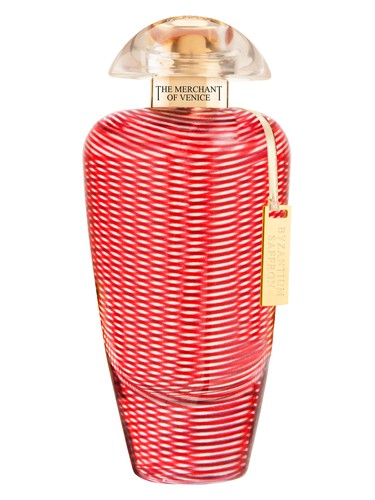
First Impressions
The first spray of Byzantium Saffron feels like stepping into a spice merchant''s quarters in medieval Constantinople—opulent, mysterious, and unapologetically bold. That opening hit is dominated by saffron''s distinctive metallic-sweet warmth, immediately accompanied by the bite of black pepper and an herbal whisper of thyme. There''s a citric brightness from lemon that keeps this spice market from feeling too heavy, though make no mistake: this is a fragrance that announces itself. The Merchant of Venice, a brand steeped in Venice''s historical connection to Eastern trade, has created something that lives up to its Byzantium namesake—rich, layered, and redolent of luxury goods transported along ancient routes.
The Scent Profile
Byzantium Saffron''s composition reads like a study in contrasts, balancing the familiar with the unexpected. Those opening moments are firmly rooted in the warm spicy accord that defines this fragrance at 100% intensity. The saffron—one of the world''s most precious spices—provides a golden, almost dusty sweetness that''s neither gourmand nor strictly herbal. Black pepper adds a crackling heat, while thyme contributes an aromatic, slightly green quality that prevents the opening from veering too oriental. The lemon is subtle, more of a brightness adjustment than a starring role.
As the fragrance settles into its heart, something fascinating happens: white suede emerges as the true protagonist. This leather accord, registering at 98% in the fragrance''s profile, transforms the spicy opening into something altogether more intimate and textural. It''s a soft, almost powdery leather—nothing harsh or animalic about it. Cedar provides woody structure (that 75% woody accord making its presence felt), while white lily and lilac add a surprisingly delicate floral dimension. The rhubarb is an intriguing choice, contributing a tart, slightly green fruitiness that keeps the composition from becoming too straightforward.
The base anchors everything in earthy sensuality. Indonesian patchouli leaf—specifically noted in the composition—brings that characteristic dark, slightly chocolate-tinged earthiness that modern patchouli lovers appreciate, registering at 51% in the accord breakdown. Crystal amber rounds out the foundation with warmth and a subtle muskiness (49% musky accord), creating a skin-close finish that lingers for hours.
Character & Occasion
The seasonal data tells a clear story: Byzantium Saffron is a cool-weather champion. With fall scoring 100% and winter at 80%, this is unquestionably a fragrance for when temperatures drop and you want something with substance and warmth. Spring wearability sits at 47%—perfectly feasible on cooler spring days, but this isn''t a fragrance that thrives in genuine warmth. Summer, at just 20%, confirms what the nose already knows: save this for air-conditioned spaces if you must wear it in heat.
The day-to-night versatility is notable, with 71% for daytime and 67% for evening wear. That white suede accord keeps it refined enough for professional settings—this isn''t the aggressive leather of a motorcycle jacket, but rather the supple luxury of Italian gloves. The saffron and spice give it enough presence for evening events without requiring you to change fragrances between office and dinner.
This is marketed as a feminine fragrance, but the leather-forward, spicy character makes it thoroughly unisex in practice. It would suit anyone drawn to sophisticated, warm compositions with personality.
Community Verdict
Surprisingly, despite a respectable 3.98 out of 5 rating from 632 voters, Byzantium Saffron appears to fly somewhat under the radar in fragrance communities. The provided community data yielded no specific discussion of this fragrance—a curious absence for a perfume with over 600 ratings. This middle score of 3.98 suggests a solid but not spectacular reception, likely appreciated by those who discover it but not generating the passionate following that drives extensive online conversation. It''s the kind of fragrance that satisfies without necessarily inspiring evangelism—competent and wearable, perhaps, rather than groundbreaking.
How It Compares
The list of similar fragrances places Byzantium Saffron in illustrious company: Chanel''s Coco Noir, Maison Francis Kurkdjian''s Baccarat Rouge 540, Guerlain''s Shalimar, Kenzo Jungle L''Elephant, and Tom Ford''s Black Orchid. This comparison set reveals Byzantium Saffron''s positioning among warm, luxurious, somewhat oriental compositions with leather or woody-amber characteristics.
Where Baccarat Rouge 540 goes crystalline and ethereal, Byzantium Saffron stays earthy and grounded. Against Black Orchid''s gothic intensity, it offers a more wearable, daytime-friendly interpretation of leather and spice. It shares Coco Noir''s refined warmth but substitutes the Chanel''s cocoa-patchouli depth for saffron''s metallic brightness. Among these competitors—most from heritage luxury or cult niche brands—Byzantium Saffron represents a less-discussed alternative that delivers similar warmth and complexity.
The Bottom Line
Byzantium Saffron sits in that interesting middle territory: well-crafted and genuinely pleasant, with a 3.98 rating that reflects solid appreciation without fanatic devotion. The Merchant of Venice has created something authentically evocative of its inspiration—a spice-route fragrance that feels historically inspired without being dated.
Who should seek this out? Anyone drawn to saffron fragrances but wanting something less sweet than gourmand interpretations. Leather lovers looking for a softer, more approachable expression. Those building a fall and winter wardrobe who want something distinctive but not challenging. At an unknown concentration and variable pricing depending on market, value is hard to assess definitively, but this brand typically positions itself in the accessible-luxury tier—more attainable than pure niche, more interesting than mass-market designer.
The lack of community buzz might actually be a draw for some: this is a fragrance that won''t have everyone asking "what are you wearing?" but will quietly distinguish you from the Baccarat Rouge crowd. It''s the scent equivalent of knowing a excellent restaurant that tourists haven''t discovered yet—rewarding for those who find it, if not exactly essential.
AI-generated editorial review