First Impressions
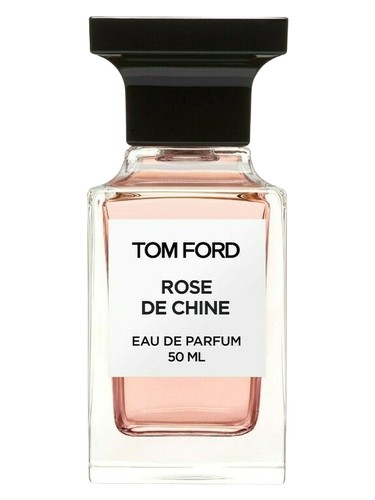
The first encounter with Rose de Chine is unexpectedly reserved. While the name conjures images of silk brocades and lacquered treasures, the opening spray reveals a perfume more interested in whispers than declarations. Chinese peony greets the skin with a soft, fresh floral quality—not the dewy brightness of Western peonies, but something more powdered and restrained. It''s a polite introduction, perhaps too polite for those expecting Tom Ford''s typically bold signature. This initial modesty has proven divisive: some find it sophisticated, others simply underwhelming.
The rose accord begins to emerge almost immediately, but it''s woven so seamlessly with the peony that the transition feels less like an evolution and more like a gradual coming into focus. There''s a crispness here, a clean quality that reads as unexpectedly fresh for a fragrance destined to settle into amber warmth. This is not the jammy, indolic rose of vintage perfumery, nor is it the sharp, thorny interpretation of modern niche fragrances. It occupies a middle ground that will either strike you as refined or forgettable, depending on your appetite for subtlety.
The Scent Profile
Chinese peony carries the opening act with a delicate hand, offering a floral introduction that feels more botanical garden than hothouse. It''s luminous without being loud, providing a fresh framework that prevents the composition from feeling heavy despite its amber classification. This top note phase is brief but essential—it establishes Rose de Chine as a fragrance with Eastern sensibilities, even if the execution doesn''t quite capture the exotic mystique the name suggests.
The heart reveals where this perfume truly lives: rose, presented in its most wearable iteration. This isn''t a soliflore study or a photorealistic rendering of petals on the stem. Instead, the rose here is diffused, softened, made graceful through restraint. It carries a subtle warmth, hinting at the amber that will soon dominate, while maintaining enough floral character to justify the name. The rose accord achieves complete dominance in the formula''s structure, yet paradoxically, it never feels overwhelming. It''s a rose you could wear to a business meeting or a first date—versatile to the point where some might find it safe.
The base is where Rose de Chine makes its most interesting statement. Myrrh and labdanum create an amber foundation that shifts the fragrance from fresh floral territory into something decidedly more resinous and enveloping. The myrrh brings a subtle smokiness, almost medicinal in its herbal quality, while labdanum adds depth and a gentle sweetness that never tips into gourmand territory. This is where the fragrance truly comes alive, transforming from pleasant to compelling. The balsamic notes emerge here too, adding a textured warmth that makes the dry down the most satisfying phase of the wear. Those who dismissed Rose de Chine at first spray often find themselves reconsidering during this final act.
Character & Occasion
Rose de Chine positions itself firmly as a transitional fragrance, excelling in spring (where it scores perfectly) and fall (nearly as strong at 89%). The fresh opening makes it entirely appropriate for warmer months, though the amber base provides enough substance for winter wear. Summer compatibility sits at 52%—perfectly wearable but perhaps lacking the refreshing lift some prefer in true heat.
This is overwhelmingly a daytime fragrance, with 89% of wearers associating it with daylight hours. Yet it maintains enough sophistication for evening wear at 57%, making it one of those rare versatile pieces that can transition from office to dinner without feeling out of place in either setting. The balanced composition makes it suitable for anyone regardless of gender preference, though Tom Ford markets it as feminine. This unisex quality has proven to be one of its most appreciated characteristics.
The ideal wearer appreciates subtlety over projection, development over immediate impact. This is for someone building a considered wardrobe rather than seeking a signature scent that announces their presence across a room.
Community Verdict
Among the 25 community voices analyzed, Rose de Chine generates a sentiment score of 6.5 out of 10—decidedly middle ground. The pattern is consistent: initial ambivalence giving way to appreciation during the dry down. Multiple wearers specifically praise how the fragrance develops, with the base notes earning considerably more enthusiasm than the opening.
The unisex versatility receives consistent praise, making it accessible to a broader audience than typical feminine-marketed fragrances. Practical-minded consumers highlight the travel atomizer set as offering genuine value, allowing exploration of this and other Tom Ford roses without committing to a full bottle''s premium pricing.
The criticisms center on that lackluster first impression. When placed alongside Rose D''Amalfi from the same collection, several voices find Rose de Chine less memorable, less immediately captivating. The premium price point amplifies this concern—at Tom Ford pricing, even modest disappointment feels significant. For those unable to test before purchasing, the investment represents genuine risk.
Former fans of Shanghai Lily (a discontinued Tom Ford fragrance) find particular appeal in Rose de Chine, suggesting some tonal overlap that bridges the gap left by that beloved scent''s absence.
How It Compares
Rose de Chine exists in formidable company. Portrait of a Lady by Frederic Malle remains the gold standard for rose-patchouli-amber compositions, offering more drama and depth. Within Tom Ford''s own range, Rose Prick delivers more edge, while Rose D''Amalfi brings coastal brightness. Chergui by Serge Lutens offers a smokier, more overtly spiced interpretation of rose-amber marriage, and Grand Soir by Maison Francis Kurkdjian provides a more contemporary, polished take on amber warmth.
Among these distinguished peers, Rose de Chine occupies the safe middle—less challenging than Chergui, less distinctive than Portrait of a Lady, more subdued than its Tom Ford siblings. It''s the fragrance you choose when you want the category''s comforts without its excesses.
The Bottom Line
With a rating of 3.84 out of 5 across 639 votes, Rose de Chine lands exactly where the wearing experience suggests: solidly good, occasionally very good, but rarely exceptional. It''s a fragrance that improves with patience and rewards those willing to wait for the base notes to emerge. The journey from fresh floral to amber warmth is well-executed, even if the destination isn''t particularly novel.
The value proposition requires honest assessment. At Tom Ford''s pricing, this represents a considerable investment for a fragrance that many find merely pleasant rather than extraordinary. The travel atomizer format emerges as the smartest entry point, allowing you to experience the dry down multiple times before committing to a full bottle. Those who find rose-amber combinations comforting rather than boring will appreciate the refinement here. Those seeking the next great rose or a fragrance that justifies premium pricing may want to sample extensively before purchasing.
Try Rose de Chine if you value subtlety, enjoy fragrances that develop slowly, or need a versatile rose that works across multiple seasons and occasions. Skip it if you prefer immediate impact or already own Portrait of a Lady or Rose Prick—the overlaps may not justify the addition. It''s good perfumery executed well, just not transcendent perfumery that demands ownership.
AI-generated editorial review