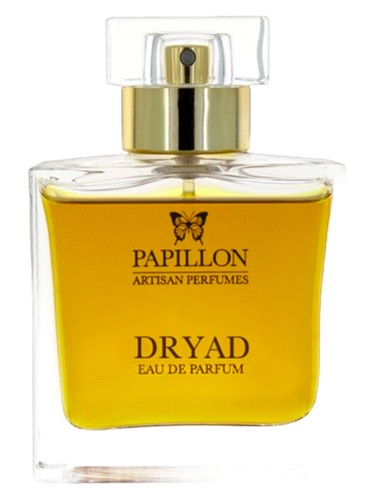
First Impressions
The first spray of Dryad is an immediate declaration of intent—this is not a fragrance that whispers. A rush of galbanum bursts forth with the sharpness of snapped stems, while tarragon and thyme weave an unexpectedly culinary thread through the green. There''s something almost confrontational about this opening, a bitter-bright collision of citron and bergamot that seems determined to shake you from whatever olfactory complacency you might have carried into the moment. Liz Moores, the nose behind Papillon Artisan Perfumes, has created something that feels less like a commercial venture and more like a manifesto: green perfumery as it was meant to be, uncompromising and visceral.
The name evokes Greek mythology''s tree nymphs, those ethereal spirits bound to their forests, and there''s something appropriately feral about this composition. This isn''t the manicured green of a botanical garden; it''s the untamed undergrowth, the forest floor after rain, earth still clinging to roots.
The Scent Profile
That formidable opening—dominated by galbanum''s resinous bite and supported by an herb garden''s worth of aromatics—gradually begins its transformation. The clary sage adds a slightly wine-like, almost narcotic quality, while bitter orange provides just enough brightness to keep the composition from becoming too heavy. The tarragon, unusual in perfumery, contributes an anise-like sweetness that plays beautifully against thyme''s more medicinal edge.
As Dryad settles into its heart, the composition reveals unexpected softness. Narcissus emerges with its characteristic green-floral earthiness, finding kinship with orris root''s powdery elegance. Here, costus—a root note increasingly rare in modern perfumery due to regulatory restrictions—adds a distinctive animal warmth and depth. An apricot note provides a brief moment of golden sweetness, while orange blossom and lavender bridge the gap between the aggressive opening and the earthier territories below.
The base is where Dryad truly reveals its classical heritage. Oakmoss anchors the composition with its distinctive bitter-green character, marking this firmly as a chypre despite its radical herbal leanings. Vetiver adds its characteristic smoky-grassy quality, while a trio of balsamic notes—Peru balsam, benzoin, and styrax—provides warmth and resinous depth. The result is a foundation that feels both timeless and distinctly alive, as if the fragrance itself is still growing, still changing.
Character & Occasion
With spring scoring a perfect 100% and fall close behind at 90%, Dryad is unmistakably a transitional season perfume. It thrives in those liminal moments: early spring when the earth is just beginning to warm, or autumn when green things begin their slow return to soil. Summer wearers (56%) will find it rewarding on cooler days, though its aromatic intensity might feel overwhelming in heat. Winter, at 38%, is clearly not its natural habitat.
The day-to-night split (89% day, 44% night) tells an interesting story. This is fundamentally a daylight fragrance, one that seems to draw energy from natural light. It''s the scent of morning walks through damp woodland, of herb gardens visited mid-morning, of outdoor lunches in cool weather. Evening wear isn''t impossible—that 44% night score suggests some do carry it into darker hours—but this isn''t a fragrance that glitters under artificial light.
The data confirms what the composition suggests: Dryad is unapologetically feminine in its original designation, though its herbal aromatic character (100% aromatic accord, 64% green, 58% earthy) might appeal to anyone drawn to green, earthy compositions regardless of gender conventions.
Community Verdict
The Reddit fragrance community''s response to Dryad reveals telling patterns. With a moderate sentiment score of 6.5/10 based on 22 opinions, this is clearly a divisive fragrance that inspires strong reactions in both directions. The pros center on its unique herbal-aromatic character, with wearers praising its distinctive profile and excellent performance. Those who connect with Dryad seem to genuinely appreciate its uncompromising nature—this is a fragrance for people actively seeking something different.
The cons, however, are equally instructive. Community members note that Dryad is notably polarizing, the kind of scent that prompts immediate love-or-hate reactions. Perhaps most revealing is the observation that it doesn''t appear frequently enough in community discussions to build strong consensus. This suggests that while Dryad has its devoted admirers, it remains a niche offering even within the niche-curious fragrance community.
The recommendation is clear: this is for those who actively seek distinctive herbal and aromatic profiles, not for anyone approaching perfume casually or looking for easy-wearing signatures.
How It Compares
The similar fragrances list reads like a who''s who of sophisticated green and chypre perfumery. Tauer''s L''Air du Desert Marocain and Guerlain''s Vol de Nuit and Mitsouko represent the classical side of the equation—complex, reference-level compositions. Serge Lutens'' Fille en Aiguilles and MDCI''s Chypre Palatin occupy similar territory: uncompromising, artistic, demanding.
What distinguishes Dryad is its specifically herbal intensity. Where Mitsouko offers peach and spice, and Fille en Aiguilles focuses on pine and frankincense, Dryad commits fully to its kitchen-garden aromatics. It''s perhaps the most literally "green" of these comparisons, the most rooted in living plant material.
The Bottom Line
With a rating of 4.15/5 from 623 voters, Dryad sits in that interesting territory of widely appreciated but not universally loved. This isn''t a fragrance flaw—it''s the natural result of creating something with a strong point of view.
Should you try it? If you''ve ever smelled galbanum and thought "more of this, please," absolutely. If you find yourself drawn to the references mentioned above, or if you''re specifically seeking something that challenges contemporary sweet-woody-amber dominance, Dryad deserves your attention. Its performance is reportedly strong, so you''ll get your money''s worth in longevity and projection.
But if you prefer your florals soft, your greens polite, or your perfumes universally pleasant, Dryad will likely feel like too much. And that''s exactly as Liz Moores intended—a forest spirit isn''t meant to be domesticated.
AI-generated editorial review