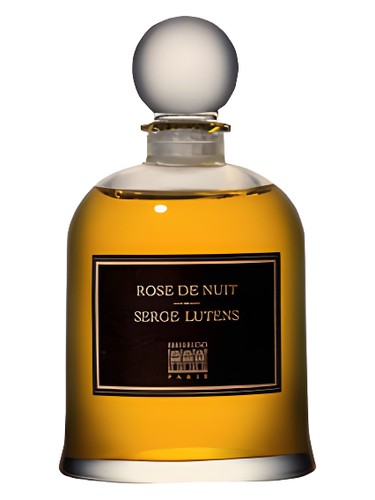
First Impressions
The first spray of Rose de Nuit announces itself with the kind of confidence that Serge Lutens built his reputation on in the early 1990s. This is not your grandmother''s rose—or perhaps it is, but discovered in her most private drawer, dusted with vintage face powder and wrapped in fur. The opening suggests a rose caught in twilight, its petals heavy with the day''s warmth but already yielding to something darker, more carnal. There''s an immediate richness here, a tactile quality that feels almost visible in the air, like watching incense smoke curl in dim light.
What strikes you most is the contradiction: this rose is simultaneously soft and assertive, feminine yet unapologetically sensual. It bypasses the typical fresh, dewy rose narrative entirely, choosing instead to present the flower as if pressed between the pages of a leather-bound book, aged to perfection with time and skin contact.
The Scent Profile
Rose de Nuit operates without the traditional roadmap of clearly delineated top, heart, and base notes—a compositional choice that speaks to Lutens'' artistic approach in this early creation. Instead, the fragrance reveals itself as a complete portrait from the start, with layers that shift and breathe rather than progress in linear fashion.
The rose itself dominates completely, but this is rose as concept rather than literal garden variety. It arrives enveloped in a powdery veil that accounts for much of the fragrance''s vintage character—think the soft finish of cosmetic powder, with its faintly sweet, slightly chalky texture. This powdery quality works with a prominent musk accord to create an intimate, skin-like effect that reads as deeply personal rather than overtly floral.
The beeswax note introduces a honeyed warmth with a waxy, almost lipstick-like quality that reinforces the cosmetic powder impression. Together, these elements craft something that feels like the memory of beauty rituals from another era. But just when the composition threatens to become too polite, too ladylike, an animalic undercurrent emerges—subtle but unmistakable, adding body heat and a hint of provocation. This is where Rose de Nuit earns its "de Nuit" designation: there''s something here that only reveals itself in proximity, in darkness, in private moments.
The woody foundation provides structure without asserting itself overtly, allowing the rose and its supporting cast to maintain center stage while preventing the composition from floating away into pure abstraction.
Character & Occasion
The community data tells a clear story: Rose de Nuit belongs to night, achieving a perfect 100% rating for evening wear while managing only 46% for daytime appropriateness. This is a fragrance that waits for the sun to set, for lights to dim, for intimacy to become possible. It''s not that you couldn''t wear it during the day—but why would you want to? Its real magic happens when the world narrows to closer quarters.
Seasonally, this scent finds its stride in fall (85%) and winter (74%), when its richness and warmth match the weight of the air. Spring sees a moderate 30% rating, while summer''s 21% suggests this is definitively not a warm-weather proposition. The powdery musk and animalic qualities could feel suffocating under summer sun, but wrapped in a cashmere coat on a December evening, they become exactly right.
This is positioned as a feminine fragrance, but its boldness and the vintage character of its composition suggest it would be equally compelling on anyone drawn to unapologetically sensual florals. The wearer who reaches for Rose de Nuit isn''t looking for fresh or pretty—they''re seeking complexity, depth, and that elusive quality of smelling expensive and intentional.
Community Verdict
With a solid 4.1 out of 5 stars across 475 votes, Rose de Nuit has clearly found its admirers. This rating suggests a fragrance that delivers on its promise while perhaps being too specific, too particular in its vision to achieve universal adoration. And honestly, that feels appropriate. This isn''t a crowd-pleaser; it''s a statement piece. The voters who connect with it likely connect deeply, while those expecting a more conventional rose walk away puzzled. That polarization within a generally positive rating is often the mark of something genuinely artistic rather than commercially calculated.
How It Compares
The fragrance finds itself in distinguished company among similar scents: Chanel''s Coco Eau de Parfum, Frederic Malle''s Portrait of a Lady, Amouage''s Lyric Woman, and Guerlain''s Samsara. This comparison list reads like a who''s who of luxury rose-forward compositions with vintage sensibilities. While Portrait of a Lady might offer more incense-heavy drama and Lyric Woman more obvious opulence, Rose de Nuit stakes its claim with that distinctive powdery-animalic combination that feels particularly French, particularly Lutens. Its kinship with La Fille de Berlin from the same house suggests this nocturnal rose approach is a recurring theme in Lutens'' exploration of the note.
The Bottom Line
Rose de Nuit represents Serge Lutens in an early creative phase, already confident enough to ignore conventions about how roses should smell. At 4.1 stars, it''s clearly resonating with those who find it, though its specificity means it won''t be everyone''s signature. The lack of concentration information makes it difficult to assess value directly, but Lutens fragrances generally command luxury pricing—and this composition justifies that positioning through sheer artistry and quality.
Who should seek this out? Anyone tired of fresh roses, anyone who wants their florals with an edge, anyone who believes perfume should be more than just pleasant. If you''ve ever wished your rose fragrance had more attitude, more mystery, more night—Rose de Nuit has been waiting for you since 1993.
AI-generated editorial review