First Impressions
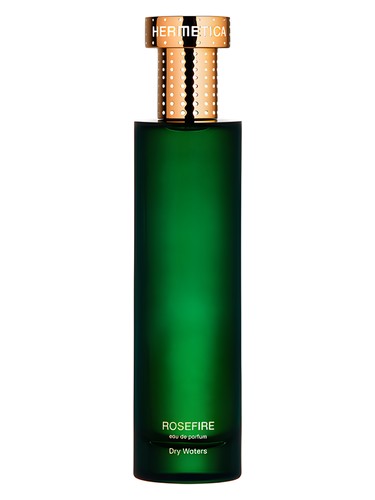
The name Rosefire promises drama—a botanical blaze, perhaps, or petals consumed by flame. What Hermetica delivers instead is something more intriguing: a rose caught mid-transformation into preserve, sweet and viscous, as if someone''s grandmother decided to bottle her prize garden blooms at their ripest moment alongside summer''s juiciest stone fruits. This isn''t the dewy morning rose of classic perfumery, nor the candied confection of many modern interpretations. Instead, the opening registers as emphatically green (42% of its accord DNA) before revealing its jammy heart—a rose that tastes as much as it smells, plump with blackberry and peach.
The alcohol-free formulation announces itself immediately. There''s no sharp ethanol bite, no immediate evaporation. Instead, Rosefire settles onto skin with a different weight, an oily richness that clings rather than dissipates. For some, this creates an intimacy, a scent that stays close and personal. For others, particularly in warmer weather, it can feel sticky, almost too present.
The Scent Profile
Hermetica remains characteristically mysterious about the specific note breakdown of Rosefire, but the accord analysis tells the story with clarity. Rose dominates completely at 100%—this is unambiguously a rose fragrance, never apologetic, never subtle. But the supporting cast makes all the difference.
That substantial green accord (42%) provides the opening structure, suggesting stems and leaves, garden earth and crushed foliage. It''s what prevents Rosefire from tumbling immediately into sweetness, offering instead a brief moment of botanical authenticity before the floral heart (41%) and violet nuances (38%) emerge. The violet adds a powdery softness (27% powdery accord) that rounds the edges, though never enough to veer into old-fashioned territory.
What makes Rosefire distinctive is its fruit-forward character, though curiously unlisted in the official notes. The community consistently identifies blackberry and peach, creating that "jammy" quality that defines the fragrance''s personality. It''s the aromatic accord (31%) that likely carries these impressions—herbal, slightly medicinal undertones that give the fruit notes complexity beyond simple sweetness.
The development remains relatively linear, which some find comforting and others limiting. There''s no dramatic transformation, no plot twist in the dry down. What you experience in the first fifteen minutes remains largely consistent through the wear, the various accords mingling rather than taking turns. This steadiness has earned both praise (for reliability) and criticism (for lack of intrigue) from the community.
Character & Occasion
The seasonal data paints a clear portrait: Rosefire is a fragrance born for spring (100%) but equally comfortable as temperatures drop. It performs remarkably well in fall (86%) and winter (71%), making it that rare floral that doesn''t wilt when the thermometer plunges. Summer scoring sits at a respectable 57%, though the alcohol-free formula can feel heavy in genuine heat.
This is decisively a daytime rose (94%), the kind you wear to weekend farmers'' markets, garden parties, or casual Friday afternoons. Yet with 67% night suitability, it possesses enough depth to transition into evening hours—particularly during cooler months when its richness feels appropriate rather than cloying.
The feminine categorization reflects traditional marketing, but the green and aromatic elements give Rosefire crossover appeal. Anyone who appreciates fruit-forward florals without excessive sweetness will find something to love here, regardless of gender. It''s particularly suited to those who want rose without the powdery, lipstick-like associations or the sharp, metallic edges of some modern interpretations.
Community Verdict
With a 7.5/10 sentiment score and 3.75/5 rating across 343 votes, Rosefire enjoys solid appreciation without reaching cult status. The 44 community opinions reveal consistent themes: people genuinely enjoy the unique fruity-jammy composition, with multiple references to Lush''s Rose Jam as a comparison point—high praise in fragrance circles where that particular scent inspires devotion.
The alcohol-free formula generates mixed responses. Advocates appreciate the skin-friendliness and lasting power. Skeptics note the limited evolution and occasional stickiness in warm conditions. Several users specifically recommend it for cooler weather and winter wear, where the formula''s richness becomes an asset.
The most telling aspect? Limited overall discussion. Rosefire doesn''t generate the passionate discourse of niche darlings. It''s well-liked by those who try it but hasn''t captured broader imagination. This may reflect Hermetica''s relatively young presence in a crowded market or the fragrance''s straightforward nature—sometimes perfumes that do one thing very well simply don''t inspire lengthy analysis.
How It Compares
The similarity list reads like a rose-lover''s wish list: Delina, Portrait of a Lady, Roses Vanille, Lady Vengeance, Bal d''Afrique. These are substantial, confident florals that don''t apologize for their presence. Rosefire holds its own in this company, though it leans fruitier and less complex than Portrait of a Lady, more wearable than the vanilla-heavy Roses Vanille, and greener than Delina''s lychee-rose sweetness.
Its closest cousin is likely Lady Vengeance with its rose-patchouli combination, though Rosefire trades earthiness for fruit. The Bal d''Afrique comparison likely stems from shared vibrancy rather than actual scent similarity—both possess that "happy" quality that makes you want to smell your wrist repeatedly.
The Bottom Line
Rosefire succeeds at what it sets out to do: deliver an unconventional rose experience through a fruit-jam lens. At 3.75/5, it''s solidly good without being transcendent, well-crafted without being groundbreaking. The alcohol-free formula is genuinely interesting for those with sensitivities or philosophical preferences, though it does impose practical limitations.
Who should try it? Anyone intrigued by the Rose Jam comparison, those seeking rose fragrances for cold weather, and people curious about alcohol-free perfumery. Skip it if you prefer classic, refined roses or live somewhere perpetually warm and humid.
The real question Rosefire poses: Is a fragrance''s accessibility a strength or weakness? Its straightforward nature makes it immediately likeable but perhaps ultimately forgettable. Sometimes that''s exactly what you want—a beautiful, wearable scent that simply makes you smell delicious without demanding analysis. By that measure, Rosefire burns bright enough.
Reseña editorial generada por IA