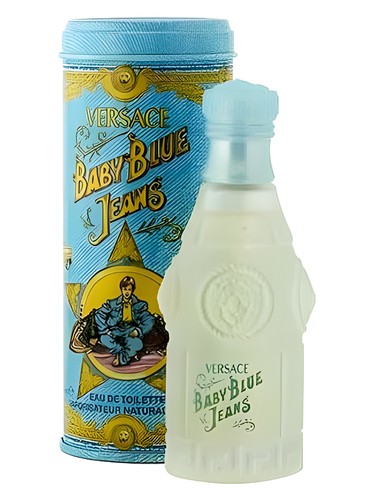
First Impressions
The first spray of Baby Blue Jeans is like stumbling upon a forgotten chapter in Versace''s fragrance archives—a chapter written in pure citrus optimism. Lime, bergamot, and mandarin orange cascade together in a wave that feels unmistakably mid-90s: bright, uncomplicated, and refreshingly direct. This isn''t a perfume that announces itself with complexity or mystery. Instead, it greets you like a sun-bleached photograph from 1995, when masculine fragrances could be joyfully straightforward without apology. The citrus opening dominates so completely—registering at 100% in the accord analysis—that everything else becomes supporting cast to this zesty, effervescent lead performance.
The Scent Profile
The journey from top to base in Baby Blue Jeans follows a trajectory that feels both familiar and slightly enigmatic, perhaps because so few have documented its development in detail. The opening trio of citrus notes creates an almost overwhelming brightness, a lime-forward cocktail tempered by bergamot''s sophisticated bitterness and mandarin''s sweeter, rounder edges. It''s a combination that practically defines summer freshness, though there''s nothing particularly innovative about it—which, depending on your perspective, is either its greatest strength or its most glaring limitation.
As the citrus begins to settle, the heart reveals a more intriguing personality. Iris brings a subtle powdery quality (57% powdery accord) that adds unexpected refinement to what could have been merely sporty and casual. Rosemary contributes an aromatic herbal dimension (45% aromatic accord), while galbanum introduces a green, slightly resinous bite (31% green accord) that keeps the composition from veering into pure cologne territory. This middle phase is where Baby Blue Jeans reveals whatever ambitions it might have had beyond being simply "fresh."
The base notes suggest a more substantial foundation than the opening might promise. Vanilla, musk, sandalwood, cedar, and patchouli combine to create a woody backbone (76% woody accord) that grounds all that citrus energy. The vanilla prevents the woods from becoming too austere, while the musk adds skin-like warmth. Yet even here, the composition never quite commits to depth—it remains resolutely surface-level, a fragrance designed for immediate impression rather than slow revelation.
Character & Occasion
The data tells a remarkably consistent story about when and where Baby Blue Jeans belongs: firmly in the daylight hours of warm weather. With summer and spring both scoring near 79% and 78% respectively, and a stark day/night split of 100% day to merely 15% night, this is unambiguously a fragrance for sun-drenched moments. Fall claims only 33% suitability, while winter barely registers at 16%—these numbers suggest a scent that wilts in cooler temperatures, unable to project the warmth or spice needed for cold weather comfort.
Who is Baby Blue Jeans for? The name itself suggests a younger demographic, someone who in 1995 might have worn it as their first "real" fragrance before graduating to something more substantial. Today, however, its audience seems to have shifted: collectors seeking vintage Versace pieces, those who remember it from their youth, or fragrance enthusiasts curious about discontinued scents that exist more as historical footnotes than current recommendations.
Community Verdict
Here''s where the story of Baby Blue Jeans becomes particularly interesting—or frustratingly sparse, depending on your expectations. With a sentiment score of 7.5/10 based on 19 opinions, the fragrance enjoys modestly positive regard, but the community discussion reveals more about what Baby Blue Jeans is than what it does.
The pros are telling: it''s valued as a collectible vintage fragrance, respected as part of the Versace lineage, mentioned alongside other quality fragrances in serious collections. These aren''t tributes to its olfactory brilliance or exceptional performance—they''re acknowledgments of its historical significance. The cons are equally revealing: limited community discussion, insufficient data on performance and longevity, a scent profile that remains largely undocumented in detailed reviews.
The community summary puts it bluntly: Baby Blue Jeans "appears in a serious collector''s inventory" but "lacks detailed community commentary." It''s "valued primarily as a collectible piece rather than for extensively discussed performance characteristics." This is a fragrance that exists more in cabinets than in conversation, appreciated more for what it represents than for what it delivers on skin.
How It Compares
The similar fragrances listed provide useful context: Terre d''Hermès, CK One, L''Eau d''Issey Pour Homme, Versace Man Eau Fraiche, and its presumed successor, Blue Jeans. These comparisons span from the sophisticated (Terre d''Hermès) to the massively popular (CK One), suggesting Baby Blue Jeans occupies a middle ground—fresher and simpler than Hermès, but perhaps more structured than the unisex casualness of CK One. Its closest relative is obviously Blue Jeans, which likely replaced it in Versace''s lineup and achieved far greater recognition.
The Bottom Line
Baby Blue Jeans earns its 3.67/5 rating honestly—it''s neither exceptional nor disappointing, landing squarely in "pleasant but unremarkable" territory. For collectors of vintage Versace or those seeking discontinued fragrances, it represents an interesting archaeological dig into mid-90s masculine fragrance trends. For anyone seeking a daily wear citrus fragrance, however, you''d likely be better served by any number of more readily available options that deliver similar freshness with better documentation and easier acquisition.
The value proposition is complicated. As a discontinued fragrance, availability is limited and prices may be inflated beyond what the scent itself justifies. If you stumble across it at reasonable cost, it''s worth trying for its historical interest. Otherwise, this is one blue jean that''s perhaps best left in the vintage shop.
AI-generated editorial review