First Impressions
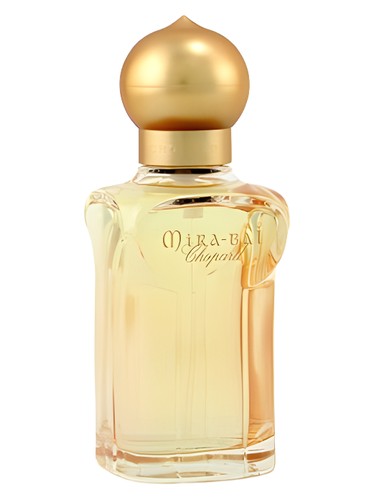
The first spray of Mira-Bai transports you to a sun-drenched orchard where ripe stone fruit weighs down the branches. This 1998 Chopard creation opens with an unabashed fruit cocktail—peach and plum jostle for attention alongside the dark, jammy sweetness of black currant, while bergamot provides just enough citric brightness to keep the opening from collapsing into syrup. It''s immediately clear this fragrance comes from an era when perfumery wasn''t afraid of full-throated sweetness, yet something in its construction—perhaps that whisper of wood smoke on the periphery—suggests depths worth exploring.
The Scent Profile
Mira-Bai''s composition unfolds like a carefully choreographed dance between fruit bowl and forest floor. Those opening moments are dominated by peach, lush and nearly tactile in its juiciness. The black currant adds a tart edge that prevents the peach and plum from reading as too candied, while bergamot weaves through with its characteristic earl grey brightness. This is fruit presented at its most opulent, the kind of generous opening that defined late-''90s feminines.
As the fragrance settles into its heart, the fruit recedes just enough to reveal a sophisticated floral trio. Rose and jasmine emerge as the primary players, but it''s the inclusion of Brazilian rosewood that truly distinguishes Mira-Bai from its contemporaries. This note—now restricted in modern perfumery—lends a spicy, slightly peppery warmth that bridges the gap between the sweet opening and the woody base to come. The florals here aren''t fresh-cut or dewy; they''re rich, slightly powdered, as if pressed between the pages of an old book.
The base is where Mira-Bai reveals its true architectural genius. Vanilla and sandalwood form the foundation, creating a creamy, skin-like warmth that could easily veer into dessert territory if not for the presence of cedar and amber. The cedar brings a pencil-shaving dryness, while amber adds resinous depth. It''s this woody-vanilla combination—reflected in the accord data showing 68% woody against 50% vanilla—that gives Mira-Bai its staying power and complexity. The fragrance dries down to something simultaneously cozy and elegant, sweet without being cloying, woody without being austere.
Character & Occasion
Mira-Bai shines brightest when autumn leaves begin to turn, which explains why 81% of wearers favor it for fall. There''s something about its fruit-and-wood composition that mirrors the season itself—the last gasp of summer''s abundance meeting the first hints of winter''s austerity. That said, 43% find it suitable for summer, and it''s not hard to understand why: worn lightly, those opening fruit notes capture something of a Mediterranean vacation, peaches eaten in dappled shade.
This is decidedly a daytime fragrance, with 100% daytime suitability according to community data, though 44% find it works for evening wear as well. It''s the kind of scent that carries you confidently through a workday without overwhelming a conference room, then transitions seamlessly to dinner with friends. The sweetness reads as approachable rather than seductive, warm rather than sultry.
Mira-Bai speaks to women who appreciate the unabashed femininity of late-''90s perfumery but want something less ubiquitous than the era''s mainstream hits. It''s for those who find minimalist fragrances a bit too restrained and prefer their perfumes to announce themselves—politely, but unmistakably.
Community Verdict
With a solid 4.18 out of 5 stars from 333 votes, Mira-Bai has quietly accumulated a devoted following. This rating suggests a fragrance that rewards those who discover it, even if it never achieved the blockbuster status of some of its stablemates. The three-hundred-plus reviewers represent a critical mass of opinion, and their collective approval indicates that Mira-Bai delivers on its promises. It''s not a polarizing fragrance—you won''t find people rating it either 1 or 5 stars in equal measure. Instead, it seems to consistently please, which for a fruity-woody composition is no small feat.
How It Compares
Mira-Bai exists in interesting company. Its similarity to Chopard''s own Casmir makes sense—both explore oriental-fruity territory with confidence. The comparisons to Dior''s Dolce Vita, Poison, and Hypnotic Poison position it firmly in the late-''90s canon of bold, unapologetic feminines, while the LouLou connection speaks to its berry-fruited opening. Where Mira-Bai distinguishes itself is in its woody backbone. While Poison leans more green-spicy and Hypnotic Poison goes full gourmand, Mira-Bai maintains that 68% woody character throughout, giving it more structure and versatility than its sweeter cousins. It''s the thinking person''s fruity fragrance—indulgent but not frivolous.
The Bottom Line
Mira-Bai deserves more attention than it receives. In an age when fruity fragrances often mean synthetic berries and pink sugar, here''s a composition that treats fruit as a legitimate facet of a complex whole rather than the entire story. The Brazilian rosewood and cedar provide sophistication, the vanilla and amber offer comfort, and that opening fruit burst provides sheer pleasure.
At 4.18 stars, this isn''t a perfect fragrance, and it shouldn''t be. Its sweetness won''t appeal to lovers of bone-dry scents, and those seeking cutting-edge modernity should look elsewhere. But for anyone curious about what made late-''90s perfumery so compelling, or for those who simply want a well-crafted fruity-woody scent that doesn''t smell like everything else at the department store, Mira-Bai is absolutely worth seeking out. It''s a reminder that sometimes the most rewarding fragrances aren''t the ones everyone''s talking about—they''re the ones waiting patiently to be rediscovered.
KI-generierte redaktionelle Rezension