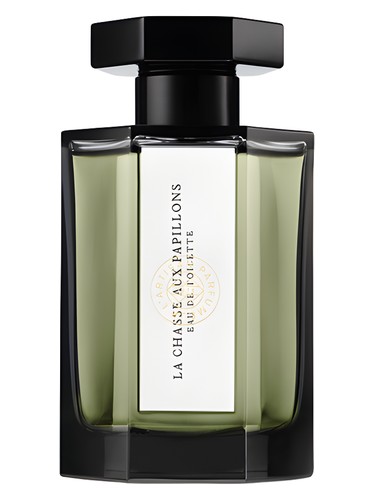
First Impressions
The name translates to "The Butterfly Chase," and from the first spray, you understand why. La Chasse aux Papillons opens like stepping into a sunlit garden where white petals drift on warm breezes and everything feels alive with movement. This is tuberose, yes—that notoriously heady, sometimes overwhelming bloom—but rendered with such delicacy and light that it seems to flutter rather than announce itself. There's an immediate sweetness tempered by green stems and pale yellow florals, creating an effect that feels both innocent and knowing. This isn't the aggressive tuberose of vintage bombshells; it's tuberose reimagined for those who chase beauty through meadows rather than command attention in ballrooms.
The Scent Profile
While L'Artisan Parfumeur keeps the specific note breakdown close to the chest, the accord structure tells a vivid story. This fragrance is absolutely dominated by white florals at full intensity, with tuberose serving as the unquestionable star at 35% prominence. But what makes La Chasse aux Papillons so compelling is how it contextualizes that tuberose—surrounding it with a supporting cast that transforms it into something softer and more nuanced than the note typically allows.
The yellow floral presence at 31% suggests jasmine or perhaps honeysuckle, adding a sunny warmth that keeps the composition from veering into the cool, waxy territory that tuberose can sometimes inhabit. At 28%, there's a notable sweetness that reads more like nectar than sugar—the kind of natural sweetness that draws actual butterflies to actual flowers. This isn't candy; it's the botanical equivalent of honey still in the comb.
Perhaps most intriguingly, there's a 20% animalic quality lurking beneath all that prettiness. This is what gives the fragrance its subtle growl, its whisper of indolic richness that reminds you tuberose isn't quite as innocent as it may first appear. It's not overwhelming—this remains firmly in daylight territory—but it provides depth and a hint of skin-like warmth that prevents the composition from floating away entirely.
The green accord at 16% likely manifests as stems and leaves, grounding the florals in something tangible and garden-like rather than purely abstract. Throughout the wear, the fragrance maintains its airy, luminous character, never developing into anything particularly heavy or resinous. This is a scent that stays true to its opening vision, evolving gently rather than dramatically transforming.
Character & Occasion
The community has spoken definitively on this question: La Chasse aux Papillons is a creature of warmth and daylight. Spring claims it at 92%—the highest seasonal affinity you'll find—while summer follows at a strong 79%. Fall and winter barely register at 17% and 12% respectively. This isn't a fragrance that adapts to cooler weather; it simply doesn't belong there.
The day/night split is even more telling: 100% day, with only 13% finding it appropriate for evening wear. This is about as pure a daytime fragrance as exists in the modern canon. Wear it to brunch in gardens, to outdoor markets, to afternoon meetings where you want to project approachability rather than authority. It's for wandering through botanical gardens, for spring weddings, for any moment when you want to smell like the best version of a sun-drenched garden.
This is unabashedly feminine in its approach—created in 1999, it predates the current trend toward gender-neutral compositions. It doesn't apologize for its floral heart or its romantic sensibility. The wearer who will love this most is someone who embraces rather than fights against traditionally feminine notes, who sees tuberose not as a cliché but as a canvas for artistry.
Community Verdict
With 3,394 votes tallying to a 4.04 out of 5 rating, La Chasse aux Papillons has earned genuine respect from a substantial community. This isn't a niche darling with only dozens of reviews, nor is it a mass-market blockbuster inflated by marketing budgets. The rating suggests a fragrance that delivers on its promises—beautiful, well-executed, occasionally exceptional, though perhaps not universally transcendent.
That 4.04 represents a fragrance worth your time and money. It's high enough to indicate real quality and broad appeal, while honest enough to acknowledge this won't be everyone's masterpiece. Some will find it too delicate, others too indolic, but many will find it just right.
How It Compares
The company it keeps is revealing: Organza by Givenchy, Pure Poison by Dior, Alien by Mugler, Datura Noir by Serge Lutens, and Poison by Dior. These are white floral heavy-hitters, though they span a range from the cosmic strangeness of Alien to the gothic darkness of Datura Noir. What they share is a willingness to let white florals command center stage, and a certain French elegance in their construction.
La Chasse aux Papillons distinguishes itself by being perhaps the lightest and most overtly garden-like of the group. Where Poison and Pure Poison have a constructed, almost abstract quality, and Alien ventures into otherworldly territory, L'Artisan's offering remains grounded in the recognizable beauty of actual flowers. It's less conceptual, more literal—and no less beautiful for it.
The Bottom Line
At over two decades old, La Chasse aux Papillons has aged gracefully, maintaining relevance in an era that often favors gourmands and woody ambers over straightforward florals. That 4.04 rating from over 3,000 voters suggests enduring appeal rather than nostalgic novelty.
This is a fragrance for those who actually like florals—not those seeking the "safest" option or the most compliments, but those who find genuine joy in the smell of gardens. It's for warm-weather lovers, daytime dreamers, and anyone who's ever chased something beautiful just for the pleasure of the pursuit. If you've been searching for a tuberose that doesn't overwhelm, or a white floral that feels alive rather than embalmed, this butterfly is worth chasing.
KI-generierte redaktionelle Rezension