First Impressions
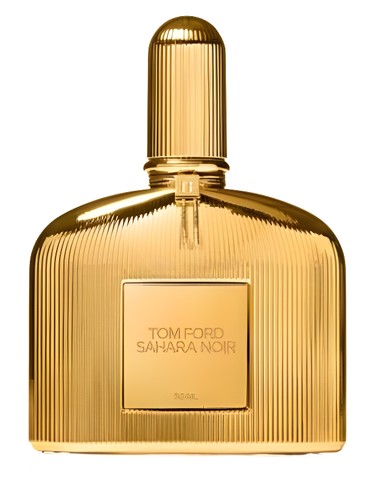
The first spray of Sahara Noir delivers what its name promises: the sweltering warmth of ancient resin melting under a merciless sun. Labdanum and bitter orange collide in the opening, creating a paradox of bright citrus cut through with dense, almost leathery depth. There''s an immediate smokiness here, accompanied by the green, aquatic whisper of calamus and the dry elegance of cypress. This is not a gentle introduction. Tom Ford designed this 2013 feminine release to transport you directly into the heart of a spice market at dusk, where sacred resins burn in hidden corners and the air itself seems to shimmer with heat.
What strikes you immediately is the amber—a wall of it, the dominant accord at full intensity. But this isn''t your grandmother''s powdery amber. This is amber with backbone, with grit, with smoke clinging to its golden threads.
The Scent Profile
As Sahara Noir settles into its heart, the composition reveals its true complexity. The incense takes center stage, flanked by the honeyed warmth of beeswax and the dusty spice of cinnamon. Here''s where the fragrance earns its reputation: this incense accord is cathedral-quality, speaking in tones both reverent and sensual. Papyrus adds a subtle paper-dry texture, while Moroccan rose and Egyptian jasmine weave through the smoke—not as floral highlights, but as supporting players adding dimension to the resinous core.
The beeswax deserves particular attention. At 12% of the accord profile, it provides a natural, waxy sweetness that bridges the gap between the bitter-bright opening and the deeper base to come. Combined with the cinnamon''s warmth, it creates an almost edible quality without tipping into gourmand territory.
The base is where Sahara Noir establishes its permanence on skin. Egyptian balsam, amber, and labdanum (appearing again, this time in its fuller, more rounded form) create a triptych of resinous warmth. Benzoin adds vanilla-tinged sweetness, while oud and cedar ground everything in woody darkness. The vanilla here is subtle—this isn''t a sweet fragrance, but rather one where sweetness serves to emphasize the bitter, balsamic, and smoky elements that define the composition.
The evolution is notably linear, which has drawn mixed reactions. This isn''t a fragrance of dramatic transformations; rather, it''s a slow burn that gradually reveals different facets of the same essential character. That woody accord (44%) provides structure, while the balsamic quality (34%) ensures the fragrance never feels thin or sharp despite its intensity.
Character & Occasion
The seasonal data tells a clear story: Sahara Noir is a cold-weather powerhouse. With 92% suitability for fall and 88% for winter, this is decidedly not a fragrance for humid afternoons or spring breezes. Those warm spicy (31%) and smoky (31%) accords demand cooler air to properly diffuse without overwhelming.
Interestingly, while it performs adequately during the day (57%), it truly comes alive at night (100%). This makes perfect sense—the incense and amber combination has an inherently nocturnal quality, conjuring images of candlelit rooms and evening rituals rather than boardrooms and coffee meetings. Though marketed as feminine, the woody and smoky elements give it enough edge to appeal across gender boundaries, particularly for those who gravitate toward oriental and resinous compositions.
This is a fragrance for someone with confidence. It projects. It lingers. It makes statements without saying a word.
Community Verdict
The Reddit fragrance community speaks with near-unanimity on Sahara Noir, giving it a positive sentiment score of 7.5/10 based on 16 opinions. The praise centers on its excellence as an incense fragrance—those who love this genre consider it among the finest executions they''ve encountered.
But there''s a significant caveat, and it''s not about the scent itself. Tom Ford discontinued Sahara Noir, and this decision has transformed it from a luxury purchase into a collector''s quest. Secondary market prices have inflated to $400-500, which the community views as excessive. While some acknowledge its potential as an investment (rare, discontinued, and genuinely excellent), many express frustration at being priced out of experiencing it.
The critical perspective, when it appears, focuses on the linear nature of the composition. Some find the one-dimensional incense profile too focused, lacking the complexity or evolution they prefer. This is fair: if you don''t love incense, no amount of beeswax and rose will save this for you.
The consensus: an excellent fragrance held hostage by scarcity and speculation.
How It Compares
Sahara Noir exists in distinguished company. Its spiritual siblings include Serge Lutens'' Ambre Sultan, Chanel''s Coco Eau de Parfum, Guerlain''s Shalimar, Tauer''s L''Air du Desert Marocain, and Dior''s Dune. Within this constellation of amber orientals, Sahara Noir distinguishes itself through its pronounced incense character and smoky intensity. Where Shalimar leans into powdery vanilla and Coco into spiced richness, Sahara Noir burns brighter and drier, with less sweetness and more resinous bite.
L''Air du Desert Marocain is perhaps its closest cousin—both evoke desert landscapes through incense and amber—but Tom Ford''s creation has a more polished, luxurious feel where Tauer''s has an artisanal, almost raw quality.
The Bottom Line
With a rating of 4.09/5 from 2,175 votes, Sahara Noir has earned its reputation honestly. This is genuinely excellent perfumery—a coherent, confident vision executed with quality materials and real artistry. For incense lovers, it deserves its cult status.
But should you pay $400-500 for it? That''s where the answer becomes complicated. If you''re a serious collector or someone for whom incense fragrances are a true passion, and if you have the budget, Sahara Noir won''t disappoint. It''s the real thing.
For everyone else, explore the alternatives first. Ambre Sultan and L''Air du Desert Marocain are still in production and offer similar territories at fraction of the cost. If you''re fortunate enough to find Sahara Noir at a reasonable price—or can sample it first—don''t hesitate. Just remember: you''re not just buying a fragrance. You''re buying a piece of discontinued luxury, with all the premium that entails.
AI-generated editorial review