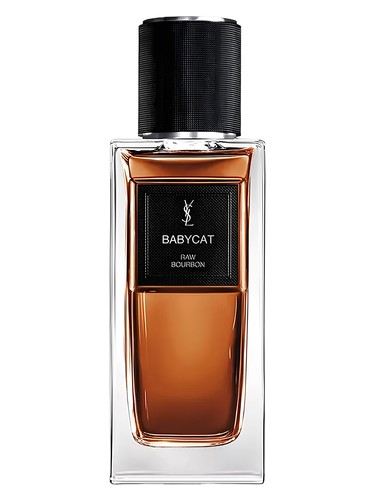
First Impressions
The first spray of Babycat Raw Bourbon announces itself with a crack of peppercorns—both black and pink—that feels less like an introduction and more like a challenge. This isn''t the YSL you might expect. Where traditional feminine vanillas whisper sweetly, this one prowls into the room with a dual-toned pepper blast that immediately signals something different. The raw in the name becomes instantly apparent: there''s an unpolished, almost defiant quality to that opening, a refusal to play by the rules of conventional gourmands. Within moments, warmth begins to bloom beneath the spice, hinting at the amber and leather heart waiting to reveal itself.
The Scent Profile
That peppery overture—sharp, tingling, alive—holds court for the first fifteen minutes, creating an intriguing tension. The pink pepper lends a fruity, almost effervescent quality, while the black pepper grounds it with earthy heat. It''s a duality that keeps your attention, refusing to settle into easy categorization.
As the fragrance opens up, the heart reveals its true ambitions. Saffron emerges like liquid gold, its honeyed, slightly metallic sweetness weaving through threads of olibanum and resins. The frankincense brings a cathedral-like solemnity, incense smoke curling through the composition with meditative depth. These aren''t decoration—they''re structural elements that transform what could have been a simple vanilla into something architecturally complex. The resins add a tacky, almost balsamic richness that clings to skin, creating the foundation for what''s to come.
The base is where Babycat Raw Bourbon truly earns its name. Vanilla dominates—the data shows it at full intensity—but this is vanilla refracted through a bourbon barrel lens. It''s not the clean, cotton-candy sweetness of typical vanilla fragrances. Instead, imagine vanilla extract in its purest form: dark, slightly boozy, with woody undertones from aging in oak. The suede accord wraps around this vanilla core like soft leather gloves, adding a tactile, almost nuzzling quality. Cedarwood provides the final anchor, its pencil-shaving dryness preventing the sweetness from ever becoming cloying. The result is a fragrance that reads as 100% vanilla in character yet somehow simultaneously expresses leather and amber at 75% intensity each—a mathematical impossibility that becomes sensory reality on skin.
Character & Occasion
This is a cold-weather companion through and through. The community data confirms what the nose knows: winter claims 100% suitability, with fall close behind at 90%. Spring barely registers at 24%, and summer? A mere 10% would dare. This makes perfect sense—Babycat Raw Bourbon is a fragrance of cashmere scarves and wool coats, of evenings when breath becomes visible in the air.
The day-night split tells an equally compelling story: 39% for daytime versus 85% for evening wear. These numbers reveal a fragrance with range but with a clear preference. During daylight hours, it maintains a certain restraint—the spice and powder (clocking in at 70% and 61% respectively) keep it from overwhelming. But as evening approaches, something shifts. The vanilla and amber intensify, the leather becomes more prominent, and the whole composition seems to expand and deepen. This is a date-night fragrance, a cocktail-dress fragrance, a "I have plans and they don''t include coming home early" fragrance.
As for who should wear it? While marketed as feminine, the leather and spice give it a bold, almost androgynous quality that could easily be shared. It''s for someone who wants their vanilla to have an edge, who appreciates sweetness but demands complexity.
Community Verdict
With a rating of 4.6 out of 5 from 817 voters, Babycat Raw Bourbon has clearly struck a chord. That''s not just a good rating—it''s exceptional, suggesting broad appeal despite (or perhaps because of) its unconventional approach to the vanilla category. Over 800 people weighed in, providing a substantial sample size that lends credibility to that impressive score. The fragrance has found its audience, and that audience is enthusiastic.
How It Compares
The comparison list reads like a who''s who of modern vanilla-amber-spice fragrances. Its closest relative is naturally Babycat, the original YSL composition from which this "Raw Bourbon" flanker takes its name. But the comparison to Nishane''s Ani is particularly telling—both fragrances explore vanilla through unexpected lenses, prioritizing complexity over comfort. Maison Martin Margiela''s By the Fireplace shares that cozy-yet-sophisticated warmth, while Grand Soir by Maison Francis Kurkdjian occupies similar amber-vanilla territory, albeit at a typically Kurkdjian level of refinement and price point. The inclusion of Emporio Armani''s Stronger With You Intensely suggests this isn''t just competing in the feminine space—it''s playing in the broader arena of unisex spiced vanillas.
What sets Babycat Raw Bourbon apart is that leather accord and the pepper opening—it''s rougher around the edges than Grand Soir, less linear than By the Fireplace, and more overtly spiced than the original Babycat.
The Bottom Line
Babycat Raw Bourbon succeeds precisely because it refuses to be polite. Yves Saint Laurent has created a vanilla fragrance for people who thought they might be tired of vanilla fragrances. The 4.6 rating from over 800 reviewers isn''t accidental—it reflects a composition that delivers sophistication, longevity (those resins and woods ensure it), and genuine personality.
Should you try it? If you''ve been searching for a cold-weather signature that''s sweet without being sugary, warm without being boring, and complex enough to reward repeated wearing, absolutely. If you love any of the comparison fragrances mentioned, this deserves a spot on your sampling list. And if you''re already a fan of the original Babycat but wish it had more grit and depth, the Raw Bourbon version might just be your perfect evolution.
This is YSL proving that even in a crowded vanilla market, there''s room for reinvention—one pepper-spiked, leather-wrapped, bourbon-barrel-aged drop at a time.
AI-generated editorial review