First Impressions
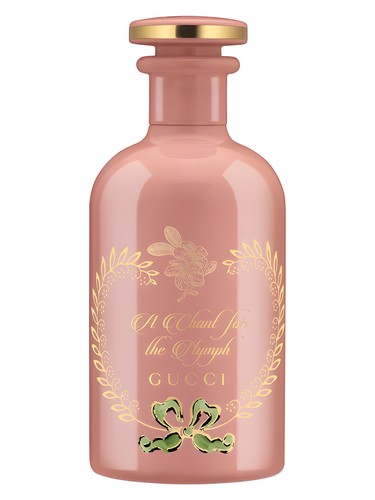
The first spray of A Chant for the Nymph is nothing short of an olfactory teleportation. Frangipani—that creamy, honeyed temple flower—floods the senses with immediate tropical opulence. This isn''t a tentative introduction or a carefully orchestrated prelude. Gucci has dispensed with subtlety entirely, opting instead for a bold declaration: you are no longer wherever you were moments ago. You are now beneath swaying palms, lei draped across your shoulders, warmth radiating from volcanic rock cooled by ocean spray.
There''s an unabashed femininity here that feels almost defiant in its lushness. The frangipani doesn''t whisper; it announces itself with the confidence of someone who knows exactly how intoxicating they are. It''s creamy without being heavy, sweet without tipping into dessert territory, and intensely floral while maintaining a surprisingly wearable translucence. Within moments, your skin becomes a canvas for something between a Hawaiian vacation and a fever dream.
The Scent Profile
Frangipani leads this composition with the authority of a soloist commanding center stage, and it never truly relinquishes that position. The top note phase is dominated by this singular star—a flower that manages to smell simultaneously exotic and oddly familiar, like a childhood memory you can''t quite place mixed with somewhere you''ve never been.
As the fragrance settles into its heart, tiare flower and ylang-ylang join the performance, creating a triptych of tropical white florals that could overwhelm in less skilled hands. But there''s a careful calibration at work here. The tiare adds a coconutty, almost monoi oil quality that enhances the sun-kissed feeling, while ylang-ylang contributes its characteristic banana-custard richness and subtle rubber-like edge that keeps the composition from becoming too pretty, too safe.
This heart phase is where A Chant for the Nymph truly earns its tropical accord rating of 74%. The florals don''t just suggest warm climates; they evoke them with such specificity that you can almost feel humidity on your skin. The yellow floral character—clocking in at 69%—manifests as a golden, slightly waxy quality that prevents the white flowers from reading as stark or cold.
The base reveals vanilla, but not the bakery-counter variety. This is vanilla as accent rather than protagonist, a soft warmth that rounds edges and adds longevity without transforming the fragrance into something gourmand. At 42% vanilla accord presence, it''s substantial enough to provide comfort but restrained enough to let those luminous white florals remain the story''s focus.
Character & Occasion
The data speaks clearly here: A Chant for the Nymph is a warm-weather darling. With a 99% summer suitability rating and 97% for spring, this is a fragrance that thrives when temperatures rise and skin is exposed. It makes perfect sense—these tropical white florals need heat to bloom properly, to diffuse into the air around you rather than sitting heavily on fabric.
The 100% day rating reveals this fragrance''s true calling. This is morning coffee on a veranda scent, brunch with friends perfume, Saturday market browsing essence. While it maintains 50% night viability, attempting to wear this to a formal evening event might feel slightly incongruous—like showing up to a black-tie affair in a floral sundress. Not wrong, necessarily, but perhaps not quite right either.
Fall at 42% and winter at 24% aren''t impossible contexts, but they''d require specific conditions: unseasonably warm days, heated indoor spaces, or perhaps deliberate contrast-seeking when the world outside is grey and you need to carry your own sunshine.
This is emphatically feminine territory. The composition makes no attempt at unisex appeal, instead embracing a particular vision of femininity that''s unfiltered and sun-soaked.
Community Verdict
With 469 voters landing at a 3.87 out of 5 rating, A Chant for the Nymph occupies interesting territory. This isn''t a universally beloved masterpiece, nor is it a polarizing experiment. Instead, it''s a well-executed example of its genre that clearly resonates with its intended audience while acknowledging it won''t be everyone''s cup of (tropical) tea.
That rating suggests a fragrance that delivers exactly what it promises without necessarily transcending its category. The substantial voter count indicates genuine community engagement—this isn''t an obscure release flying under the radar, but rather a properly tested fragrance that''s found its people while accepting it won''t convert skeptics of the tropical white floral genre.
How It Compares
The similar fragrance cohort is revealing: Guerlain''s Terracotta Le Parfum, By Kilian''s Love Don''t Be Shy and Rolling in Love, Amouage''s Love Tuberose, and Les Liquides Imaginaires'' Blanche Bête all share DNA with A Chant for the Nymph, though each takes different angles on white florals and sweetness.
Where Terracotta Le Parfum leans into summery bronzed skin, and the By Kilian fragrances embrace unabashed sweetness, A Chant for the Nymph carves its own path through sheer tropical specificity. It''s less overtly gourmand than Love Don''t Be Shy, less heady and indolic than Love Tuberose, positioning itself as perhaps the most literal vacation-in-a-bottle of the group.
The Bottom Line
A Chant for the Nymph succeeds at exactly what it sets out to accomplish: delivering an immersive, tropical white floral experience that transports without requiring excessive complexity. The 3.87 rating feels accurate—this is a very good execution of a specific vision rather than a groundbreaking composition.
For those who crave frangipani, tiare, and ylang-ylang in their purest, most unapologetic form, this fragrance delivers abundantly. For those seeking versatility across seasons, occasions, or moods, the narrow focus might feel limiting. The vanilla base provides just enough warmth to extend wearability slightly beyond pure summer, but this remains fundamentally a warm-weather creature.
Who should try this? Anyone missing beach vacations. Anyone who wears monoi oil unironically. Anyone who wishes they could bottle that specific feeling of stepping off a plane into humid tropical air. And anyone who''s ever thought that most white florals are too timid, too measured, too afraid of their own lushness. A Chant for the Nymph fears nothing—least of all being called too much.
AI-generated editorial review